
If the barrier to an acceptable gender balance in boardrooms and within our Governmental structures is referred to as a glass ceiling, perhaps there is something similar that could be used as a shorthand when it comes to our classrooms? However I am not sure my title quite captures it!
According to a recent news report, less than 25% of the teachers in Crawley are male and in two of the Schools this figure is zero. There has always been a significant difference in the gender balance between Primary Schools and Secondary Schools and clearly this
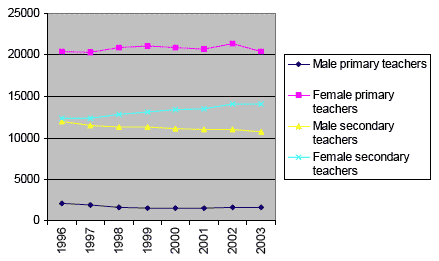 has an impact on any combined measure such as the 25% given in the paper. The graph on the Left is based on research carried out in Scotland in 2005. It reflects that across the nation as a whole, only 7%-8% of the primary teachers were male. However as the graph indicates the number of teachers in the Secondary sector was a great deal more evenly balanced. As a result of this and other studies, successive Governments have worked to increase the number of male teachers training for the Primary sector in particular, although some commentators have argued that this should not be the main priority for the Government. Nevertheless Michael Gove set a target of changing the balance in our Primary Schools to 70:30 by September 2013 and according to this radio report from July 2012, there were over 50% men entering the workforce. There is insufficient information in the report from Crawley to know why the statistic is as low as it is but clear that as far as the town is concerned Mr Gove has missed his target across the board, not just in the Primary Schools. West Sussex County Council has sought to embrace the Governments Academy Programme with enthusiasm compared to some neighbouring authorities. This means that whilst there may be a desire in Whitehall to see a more even gender balance across the nation, and perhaps in County Hall and certainly from the perspective of the town as a whole. However any sense of re-balancing the workforce is a great deal more complex if the Schools are each being run as autonomous organisations with stronger links to other schools run by the same foundation, possibly many miles away, than to the Schools in the neighbouring community. This sort of organisational structure creates huge barriers to any prospect of some teachers working across several Schools.
I have written before about the need for Boardrooms and Parliament to work towards a gender balance, in these contexts usually to increase the number of female board members or MPs. Based on this news report the same need presents itself here, albeit that more men are needed. Educationalists are not of one mind on this, and clearly the most important matter for all of us is that our children receive a good education. However in my view this does depend in part on providing good male and female role models for boys and girls. There are many ways that Schools can provide male role models for all of their pupils, outside of the provision of teachers such as through teaching assistants and mentors but on the face of it, these statistics are very worrying.


 ianchisnall