
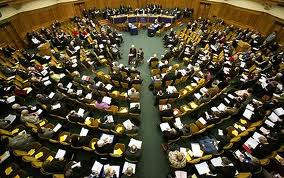
 I wrote in September with a suggestion that Parliament meets in a building where MPs are seated in a circular fashion. My proposal was in part based on the fact that the Palace of Westminster needs to be thoroughly refurbished due to its condition and age. The options open to Parliament are either a relatively short period during which it moves out of the Palace of Westminster and holds its debates elsewhere, or else a much more protracted period where builders work around Peers and MPs. My idea is that the MPs move out, and for a period hold their debates in a place where they are seated in a non-adverserial manner, just to see if this improves the quality of our national leadership. If their debates are shown to be more effective, then the refurbished House of Commons could be remodelled or else an alternative purpose found for it and a new Parliament Building created, perhaps as some have suggested outside London. Several circular auditoria do exist in the Westminster area. These include the Immanuel Centre opposite the new Home Office and Church House in Great Smith Street as well as Methodist Central Hall. The benefit may be more than merely cultural, for example Church House Synod can seat 467 members, compared to 427 in Barry’s Palace of Westminster. It also looks a great deal less barren when only a small number of people are present, particularly if they sit towards the centre of the room.
This morning on Radio 4 Today, included a debate between Stephen Pound MP and Gisela Stuart MP on the appalling debates that took place in Parliament this week, PMQs and the foodbank debate. The discussion on Radio 4 extended to a question about a circular chamber and for a few seconds I thought we were to see a break through. Sadly Gisela spoiled my moment when she suggested that she enjoyed the bear pit too much for any change to be attractive. I wonder how many of our MPs are so traumatised by the current approach that they have lost the capacity to understand the damage that is being done to their reputation by these arrangements. I was pleasantly surprised that Stephen Pound seemed more open to the concept of a circular chamber with a focus on consensus rather than confrontation.
In the spirit of reform, I would also like to see a greater emphasis on the skills that elected representatives bring to the Chamber. In any good charity, the Trustees carry out a skills audit and then focus on the missing skills in their recruitment. If the Political Parties took a similar approach we could see a few more Ministers who knew their subject from personal experience, rather than people who all see things through a PPE lens. I would also like to see an end to the public funding of Political Parties, that would save us all £7M a year and reduce the barriers to access by small parties and Independent candidates. This would also be helped by a substantially reduced limit to how much each party can spend nationally and locally so that the focus would revert to the voters judgement and not marketing campaigns paid for by silent partners behind the scenes. Finally I would like to see an overhaul of the Independent body that sets the pay and conditions of MPs and should also do the same for the Lords. I would like to see people on IPSA whose life experiences reflect parts of society that are currently missing from IPSA itself and in large part from Parliament. I hope that a renewed IPSA would reduce the freedom of MPs to earn a second income outside of Parliament, bringing their legislative priorities into question.


 ianchisnall