
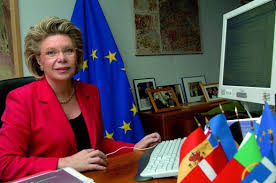
 The quality of education for our children has led Viviane Reding, the vice president of the European Commission, to warn government ministers that they should focus their energy on raising educational standards instead of blaming the country’s problems on foreigners. Whilst she is inevitably a great apologist for the EC and EU, she is also very attuned to the needs of children and has made a number of speeches about the need to educate young people effectively throughout Europe. The intervention by Ms Reding has been reported in this article in last Tuesdays Telegraph under the headline “Neglect pre-school education and we will all be the poorer” In the article by Mary Riddell, she goes on to say “Eurosceptics may dislike Miss Reding’s federalist ambitions, but even they might concede that, when it comes to our national failure, she is right.” Sadly the article goes on to suggest that one of the problems associated with early years is its cost as though the answer is simply a matter of piling up the childcare and delivering it cheap. “More than 30 years have passed since it was proved that an attainment gap between the most and the least privileged children reached 13 per cent at the age of 22 months and widened throughout childhood. Evidence shows that pre-school education improves children’s development and behaviour. Yet while comparable countries boast cheap and well-staffed nurseries, Britain has a shambolic and frankly disgraceful system manned by ill-qualified staff. A part-time nursery place now costs more than £100 a week – a 77 per cent rise in a decade.”
If driving down cost is the answer, it is certainly one that the current Minister with responsibility for childcare understands. A few days before flying to China to find out how they appear to educate their children so effectively in Mathematics Liz Truss told the Resolution Foundation that she would throw open schools to provide extended occupation for older children, slash red tape for nurseries and make it easier for parents to pay unregistered “trusted friends” to look after their children. The problem is that in practice the cost of childcare is only a problem if you compare it to other commodities. Earlier this week as I drove my Son to University we took a route out of Brighton and Hove that he is not familiar with. He commented on the number and type of luxury cars outside a home we passed. I explained that the house belonged to someone whose riches had come from washing cars. My son was intrigued and I explained the business model that has helped the owner to make some of his money and compared it to the business model that applies to childcare (my family has extensive experience of the latter). As I pointed out to Peter, the problem is that many of us will happily pay £5 for a 10-15 minute car wash, but be a great deal less happy to pay £3.50 – £4 an hour for educating our 2-4 year olds. Yet the costs of running a Pre-School and the skills needed for the staff are much more extensive to the needs of a well run car wash. This ultimately is part of the problem. Educating children needs to be done in the most cost effective manner, but it also needs to be done in a manner that adds the greater value to the children than simply getting a bucket of knowledge and even care and pouring it all over them. Working with young people, particularly the very young should cost us a meaningful sum, it should never be a commodity. This is not car washing, and we cannot afford to take the risk of mass educating our most precious citizens.


 ianchisnall