
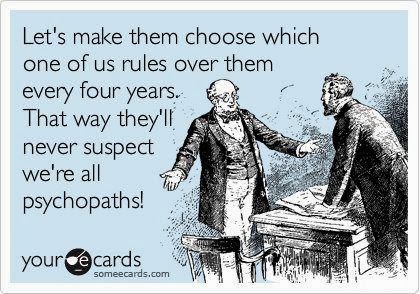
 In yesterdays Independent newspaper, Andreas Whittam Smith suggests that our Governments should be punished for poorly thought through policy announcements, in the same way that the head of OFSTED wishes to see parents punished for not ensuring their children do their homework. At one level this is what does happen. If a Government is deemed to have run the country well, they get re-elected and if not they get replaced. However there are as many problems with the metaphor as with the system that Mr Whittam Smith wants to draw attention to.
The comparison between the School room and Westminster is easy to make. The behaviour in the debating chamber may resemble a large class of students where the teacher has not arrived for the lesson as expected. The constant blaming of other people for failing to achieve the outcomes promised is something that happens occasionally in our Schools and it is almost a constant in our Parliament. As Whittam Smith suggests, to announce policies on the hoof is bound to fail most of the time. Whilst some foolhardy school children might shout out answers when they have no idea what the question really means, most do not. Most students don’t want to give the wrong answer, for fear of being found out, sadly based on the examples used in the article, some of our more powerful Politicians don’t need to worry about being wrong. They simply throw your money and my money at their half baked ideas and force them through, because they have a party that does not want to lose face. Indeed it is the existence of a Political Party and the way in which they control the space in Parliament that really separates these two worlds. In many Schools the existence of teams or ‘houses’ may assist in organising sports days and improve behaviour by injecting a bit of internal competition but its not possible for one strong willed student, no matter how popular to commit most of his or her team to a course of action that could take the whole School down.
One of the problems with the analysis in yesterdays Independent is that none of our Schools, let alone the individual students are exposed to the sort of immediate public ridicule that our Parliament faces. As much as Andreas Whittam Smith may despair about the ideas being announced by our politicians, it is his trade, the work of journalists that applies the glare of spotlights to their words and constantly challenges any hint of a U turn. We need a Parliament where new ideas can be discussed in a manner that allows plenty of room for major changes to the concept before the idea is announced as a fully formed policy. To take one of the examples, that of providing a cooked meal for all Infant School age children, no one could believe it is wrong to ensure all of our children are well fed. The link between empty stomachs and lack of concentration is well understood. The real problem with this idea is that Nick Clegg produced it during a party conference as part of the trade off for married persons allowance. The obsession with delivering it by the following Autumn without any costings or discussion is what turned it from an interesting idea to such a catastrophic failure. Yet we do need space for interesting ideas, and not just from our party leaders. What we need is not, as Whittam Smith is arguing for, punishment for our Politicians when they come out with ideas that fail, but a more fundamental change to the way in which Parliament operates. A paradigm that allows ideas to be considered in a more open context, and ensures that no one has the power to force through crackpot ideas, and stops a flip flop between Parliaments when good ideas are discarded, simply because they were thought up by the ‘wrong’ people.


 ianchisnall