
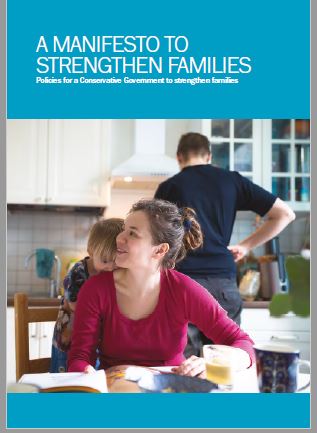
 In the House of Lords on Thursday, there was a debate which focused on a document which was published on 6th September by a Conservative MP, Fiona Bruce and Conservative Lord, Michael Farmer entitled ‘A manifesto to strengthen families’ and subtitled ‘Policies for a Conservative Government to strengthen families’. It was supported by a total of 50 other Conservative MPs including three from Sussex; Tim Loughton, Maria Caulfield and Henry Smith. There was also a list of 7 Peers who signed up to the document. Perhaps slightly uncomfortably in the light of the recent issues in the Palace of Westminster, the MPs who had signed the document included Stephen Crabb and Charlie Elphick. However signatories to a document do not in any way change the nature of the document itself.
I had not spotted its publication until I came across the debate. The document contains a small number of positive elements that I would imagine would gain support from all political parties but the majority that at their heart are deeply questionable. I will blog again about the debate itself, but first the manifesto. Page 3 of the document calls on the Government to make 8 commitments.
The first is simple if a little naive. It states “Create a Government focused on supporting families” and then goes on to call for a Cabinet level minister to be appointed to coordinate family policies which is a good approach, but then asks for a Minister in each department to be made responsible for carrying out Family Impact Assessments on policies. This is both a waste of time in departments such as MOD, Biz and DEFRA and it is a failed way of operating. The Department will of course need to check its decisions and policies for all sorts of criteria, but the point of an Impact Assessment is that it needs to be carried out by people outside of the decision making process.
The second is to “encourage every Local Authority to work with voluntary and private sector partners to deliver Family Hubs”. The challenge here is two fold. The first is that the Conservative Government has overseen a 30% reduction in the number of hubs and there is no recognition of the need for this to be reversed. The second is that ‘encouragement’ means nothing. The language needed is ‘requiring’.
The third point is deeply concerning. It relates to the need to encourage parents who are not engaged with their children to do so, but it is based on the tokens of ensuring fathers are listed on birth certificates and calling on maternity services to improve their support for fathers. With a deeply underfunded NHS this is a complete mismatch between what this group of MPs and Peers is seeking to achieve and what is realistic.
Fourthly they want to improve the financial incentives for families and this relates to complex issues such as restructuring Universal Credit and Tax allowances for low earners in relationships. The failings of Universal Credit are so manifold that this is an unhelpful connection to make. What is needed is to increase benefit levels to all people.
Then there is the completely out of touch idea that parents who are not working and who receive free childcare should be obliged to participate in a weekly stay and play session. This is deeply worrying as not all preschools and nurseries are set up for such activities and whilst there may be value in engaging such parents with their children beyond the 138 or 153 hours that they will in any case be solely responsible for them, the best mechanism for doing so will not come via a legislative one size fits all approach.
The next element is very important although its label has a few concerns. “Promote healthy relationships to tackle the country’s mental health crisis” The country does have a mental health crisis, but the promotion of healthy relationships will not address it. However the rest of the paragraph states “Ensure children and young people’s mental health services help families, offering couple counselling where this is needed. Any child experiencing domestic violence should be offered support.” These elements sound very good, but they will not address the much wider mental health issues.
Then there is a focus on relationship education which argues that it should promote a culture which supports stronger families and go beyond schools and extend to a on-line platform. Again not much to add to whatever is currently on offer.
The final element is the call to “Help prisons to put the role of families at the heart of efforts to reduce reoffending”. This seems to be a really good approach but it will require a large financial investment to be fulfilled. It seems strange that it comes from a large number of people who previously argued that prisoners should be denied the right to vote. Let us do a proper piece of work and ensure that prisoners are provided with stronger rehabilitation opportunities.


 ianchisnall