
 Over the weekend a well known extremist activist has appeared to gain a great deal of widespread support from non extremists for placing an important and highly sensitive court case involving accusations of multiple rapes at risk due to his attempts to publicise the case and state his views about the people who are accused in the case. It is painfully clear that in doing so he risks influencing the thinking of the Jury and if he achieves this the case which he claims to want to see succeed may be abandoned and at best will lead to a retrial. The people who have most to lose apart from the cost to society as a whole are the victims, yet the man concerned claims to be on their side, even though his actions are putting their prospects of justice at severe risk. He claims to be a journalist, yet if this was the case he would be fully aware of the contempt and reporting restrictions involving court cases. A useful reference point for this is the BBC Journalism Academy website which states:
“Contempt of court law protects the integrity of the legal process from outside influence. There are various types of possible reporting restrictions, some of which apply automatically while others are at the discretion of the court. One of the key aims of reporting restrictions is to prevent the publication of material which might prejudice a fair trial by influencing jurors to think that a defendant might be guilty. You can also commit a contempt of court by, for example, interviewing a witness before a trial or even by putting pressure on them to provide an interview after the trial.
Once proceedings are ‘active’, anything which creates a substantial risk that the course of justice in these proceedings will be seriously prejudiced or impeded will be a contempt of court. In most criminal cases, proceedings become ‘active’:
- On the arrest of a suspect
- When an arrest warrant is issued
- On the issue of a summons (in Scotland a complaint) or indictment. This may be well before a person in charged
- When a person in charged.
It is irrelevant whether or not you actually intended to commit contempt. These rules apply to all courts and tribunals exercising the judicial authority of the state. The risk is highest when the case is due to be heard by a lay jury – for example, in criminal trials.”
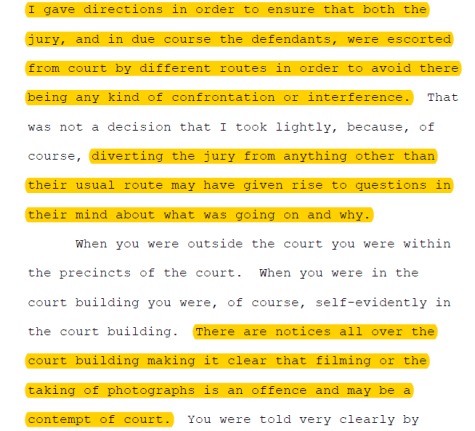
It is deeply disturbing that along with high profile supporters such as at least one UKIP member of the House of Lords and Katie Hopkins, that he has also attracted support from people who have been taken in by his arguments. One of the people who he persuaded was Judge Norton who handed him a three month suspended sentence last Monday (some of the words are shown above – the full transcript is available here) at Canterbury Crown Court, believing that he was prepared to act in an respectable manner moving forward. Yet now he has broken the terms of his suspended sentence and his supporters are blaming the Government and the mainstream media who follow the rules that are in place to protect people who are victim of crime. This is a very sad result of someone who is the equivalent of a societal hooligan being championed by credible people.


 ianchisnall