
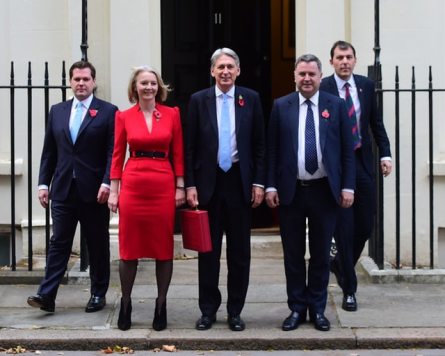
 When well-resourced and highly educated men and a woman set off from their official place of work to make a presentation to a massive audience it is understandable that they turn out smartly and make a big entrance onto the stage on which their leading speaker will be granted the chance to impress not just the people present but many others who will watch them or read their words later on. It seems vital that the opening few words will set the tone for the full 72 minutes of content. After all although the journalists and economists will focus on the detail, this is also a vital opportunity to display credibility to the whole of society, bearing in mind this is the set piece for the Chancellors year in office and he and his colleagues should have worked hard to ensure every I is dotted and every t is crossed.
“Today, I present to the House a Budget for Britain’s future: a Budget that shows the perseverance of the British people finally paying off; a Budget for hard-working families who live their lives far from this place and care little for the twists and turns of Westminster politics. People who get up early every morning, who open up factories, shops, and building sites, drop their kids off at school, check on elderly relatives and neighbours—the strivers, the grafters and the carers who are the backbone of our communities and our economy.”
It seems as though this has been written with a very clear sense of what target audience the Chancellor has when it comes to his objective of winning support, but this set of identities is very narrow and society needs a Government that is willing to look more broadly at it when it comes to policies and law making. In the same way as we need our Government to focus on the whole nation, so the need to address rather than ignore key issues is vital. If “the era of austerity is finally coming to an end” then the commitment should be for clear actions, not for minor adjustments. The particularly toxic elements of the opening paragraph was referring to people who drop their kids off at school, bearing in mind those families that lack cars and those schools that work hard to encourage children to walk to school and the fact that many people are lonely in our nation, due to their lack of a family.
When he spoke about policing, he was mostly referring to people who don’t get up early every morning as they work a wide range of shift patterns. He stated “I recognise that policing more generally is under pressure from the changing nature of crime“ which rather ignores the fact that policing is under much more pressure from the lack of budgets being offered to their services than simply changing circumstances. He did go on to say “the Home Secretary will review police spending power and further options for reform when he presents the provisional police funding settlement in December.” But this lacked any sense that there would be a substantial increase in funding at that time.
He offered schools a little bit of icing onto a cake that is clearly crumbling and his words displayed such a patronising approach to a part of society that is under great pressure “I recognise that school budgets often do not stretch to that extra bit of kit that would make such a difference. So today I am announcing a £400 million in-year bonus to help our schools buy the little extras they need—a one-off capital payment directly to schools, averaging £10,000 per primary school and £50,000 per secondary school. “The sum concerned looks more inadequate when later he stated “We are also moving forward with schools projects in Northern Ireland £300m”
He then turned his attention to the factories shops and building sites “We will make sure that British workers are equipped with the skills that they need to thrive and prosper. We have introduced a new system of T-level vocational training, we have put the first £100 million into the new national retraining scheme, and, through the apprenticeship levy, we are delivering 3 million high-quality apprenticeships” These words are complete nonsense. The T levels are not going to appear for students until the end of this Government which is due to end in 2022 and the apprenticeship levy has totally undermined the 2m apprenticeship numbers, and there is no way that the 3m target will be met.
One of the oddest parts of his speech related to public lavatories “Local authorities have long been able to provide discretionary business rates relief to other bodies, but not to themselves. I am pleased to announce a new mandatory business rates relief for public lavatories.” The irony is that if he was willing to apply the same relief to schools or other public services, this would be a meaningful way of bring funding back to these agencies although due to the way in which business rates help fund councils, they will gain with one hand and lose with another.


 ianchisnall