
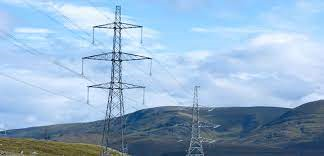
An article from the Institution of Engineering and Technology magazine that came out yesterday written by Jack Loughran began with the headline
Scotland needs more pylons to support wind power expansion, experts urge
and the first few words are Scotland “urgently” needs more pylons, power lines and substations in order to prop up new renewable energy facilities being built, Scottish Renewables has said. It will be very significant to see if the settings such as Harris and Lewis and also Uist and Skye along with Orkney and Shetland. There are also locations such as Iona, Arran and Islay. So here is the text from IET but it would be fantastic if it could identify the areas where the pylons are needed so perhaps corresponding with Jack from the locations. The IET article can be obtained from here.
Increasing the production of clean power from renewables such as wind and solar will be necessary for the UK to decarbonise its electricity system.
But while the deployment of cheap renewable energy generation has quadrupled over the past 10 years, investments in Britain’s transmission grid have remained flat and have even decreased since 2017, Scottish Renewables said in a new report.
Scotland is reliant on renewable energy more than other parts of the UK as its geography has allowed developers to build some of the biggest domestic wind farms.
In the future, more homes and businesses will be connected to heat networks and industrial sites and factories will house large batteries. There will also be a need for more electric vehicle chargers, heat pumps and solar panels.
To enable this, National Grid estimates that five times more transmission lines need to be built by 2030 than have been built in the past 30 years, at a cost of more than £50bn.
With wind energy currently costing half that generated by fossil fuels, having more pylons is also expected to help cut consumer energy bills.
Scottish Renewables’ research shows that every mile of overhead power line built enables enough renewable energy generation to displace more than 10,000 tons of CO2 from the atmosphere – the equivalent of taking 7,600 cars off the road.
Nick Sharpe, director of communications at Scottish Renewables, said: “The UK’s electricity network is not fit for purpose. While the deployment of cheap renewable energy generation has increased fourfold over the past 10 years, investment in Britain’s transmission grid has flatlined, and has even decreased since 2017.
“Electricity demand is set to increase by 50 per cent in the next decade and double by mid-century, so it’s therefore wrong to say that Scottish households don’t need more power lines, pylons and substations. We need them to keep our homes warm and ensure the lights stay on.
“Groups and individuals who object to the construction of power lines, pylons and substations largely do so because they do not like the way they look.
“By the end of this year, there will be just over 70 months left to achieve our targets of 11GW offshore and 12GW onshore wind. To ensure we maximise the enormous socioeconomic benefits this will bring to local communities, we will need a grid fit for the 21st century.”
Earlier this year, National Grid began trialling a system that can be attached to a drone to carry out live inspections of overhead transmission lines.


 ianchisnall