
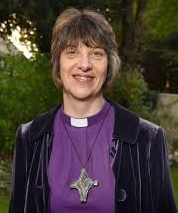
On Monday 25th March there was a session on the House of Lords for the “Amendment 172 Victims and Prisoners Bill” and the person who spoke the most was the Bishop of Gloucester who is Rachel Treweek. All of her comments are published below and the comments from the four other members of the House of Lords can be found on the full item which is available here. Her first comment is the opening of the session:
The Lord Bishop of Gloucester: Moved by The Lord Bishop of Gloucester 172: After Clause 56, insert the following new Clause—“Data collection in relation to children of prisonersThe Secretary of State must collect and publish annual data identifying—(a) how many prisoners are the primary carers of a child,(b) how many children have a primary carer who is a prisoner, and(c) the ages of those children.”
After that she then comments
My Lords, the noble Lord, Lord Farmer, tabled this amendment, to which I am very pleased to add my name in support and to move it today in this final stage of Committee on the Bill. In his absence, I take this opportunity to pay tribute to the noble Lord for his commitment to the families of prisoners. This is also an issue which I know my right reverend friend the Archbishop of Canterbury cares deeply about, as well.
This amendment was selected for Report stage in the other place but not discussed. Introduced by Harriet Harman, it is an important progress chaser to the Government’s response to the 2019 report from the Joint Committee on Human Rights, which she then chaired. This proposed new clause would require the Secretary of State to collect and publish annual data, identifying how many prisoners are primary carers of a child or children, how many children have a primary carer in prison, and the ages of those children. Its inclusion would be highly appropriate for this Bill, which focuses on both victims and prisoners.
When a parent is committed to custody, their child should not also receive a sentence; they should not be punished or overlooked as a result of their parent’s crime. When a primary carer, or indeed any parent, is removed from the home, children and other family members are deprived of a provider of care and income. Often a shadow world of shame and stigma begins, which can haunt them throughout life and put them at risk of getting caught up in the criminal justice system themselves. If we are to prevent offending and anti-social behaviour then we need to be serious about looking upstream to support those at risk. This includes children with a parent in prison.
Charities working with prisoners’ families, such as Children Heard and Seen and the Prison Advice and Care Trust, have repeatedly highlighted the gap in our understanding of the scale of parental imprisonment. I commend to noble Lords two short films released by both those charities that show the heartbreaking realities of this issue and the impact on a child when their parent is sent to prison. It also shows the remarkable work done by both charities alongside families.
The 2019 Joint Committee report highlighted the
“complete lack of reliable quantitative data on the number of mothers in prison” and
“the number of children whose mothers are in prison”.
It argued that
“without improved data collection, collation and publication” it is both
“impossible to fully understand the scale and nature of this issue and to properly address it”.
It continued:
“Mandatory data collection and publication must be urgently prioritised by the Ministry of Justice”.
A few months before that was published, Crest Advisory’s report on the children of prisoners found that
“during a parent’s journey through the criminal justice system there are numerous points which children of prisoners could be identified—on arrest, at sentencing, on entry to prison, and under probation supervision. But at the moment, at no point does the system ask: ‘If this is a parent in custody, where is their child?’”
The point of doing this would be to ensure the welfare of the children and to establish whether help is needed for the family or friends now caring for them. As that report said:
“Instead it is left up to the offender or the parent left behind to seek help—something which we know is problematic because of stigma and fear about children being taken into care”.
That is echoed again and again by the charity Children Heard and Seen, which does such fantastic work with children with a parent in prison, including a ground-breaking initiative across the Thames Valley region.
Rightly, the Government broadened their response to the Joint Committee to all primary carers, not just mothers. Many men are also in this position—albeit with a very different proportion of the male prison population compared with the female estate. Again, we are hampered by the lack of reliable data. However, the Farmer review on women in the criminal justice system, the Ministry of Justice, His Majesty’s Inspectorate of Prisons and many others highlight that relatively more women than men report being parents and, likely, primary carers.
The Government’s position in 2019 was that their aim was to establish more accurate metrics to measure the number of prisoners with primary carer responsibilities. However, they also acknowledged that gathering information about dependent children is a sensitive matter and committed to exploring the most accurate way to collect and then collate and publish that data,
“provided an accurate method can be found to estimate it, and provided it can be done in a way that protects the rights of vulnerable individuals”.
Given the significant body of evidence showing that the children of prisoners are at risk of markedly worse outcomes in areas such as mental health, underachievement at school and becoming offenders themselves, we should, at the very least, know how many children there are and their age and stage of childhood. The amendment is limited to quantitative data collection, given the inherent problems of collecting identifiers in such a delicate and sensitive area and given that a key aim at this stage is to progress-chase the Government on behalf of these particularly neglected children. I beg to move.
Four other people do contribute and then Rachel assists at the end of the session with
I thank the Minister and all other noble Lords who have spoken. I am interested in his answer, because in one way he is saying, “Yes, we need this and recognise this”, but in another is saying “But we do not actually need this amendment”. I look forward to hearing more on that. As has been pointed out, the basic custody screening tool is very basic, and many parents do not want to declare on entry to prison that they have children. I will be watching with interest the BOLD programme and what comes out of that.
It is really important that the progress the Government are making in this area is now put on public record. It is nearly five years since the Joint Committee published its report. Also, I stress that it has been important to touch on family relationships and prisoners having those family relationships, but I do not want to lose sight of the fact that this is about the child. Not all children want to have contact with the parent who is in prison. So we need to be looking through the eyes of the child here.
As has been said, when children are given support, through charities such as Children Heard and Seen, we know that the results are remarkable. If, as the noble Lord says, education and other people are going to have this data, we need the data in the first place. That is where we need to start.
Many remain very concerned about these children who are invisible and that we are not able to support them, but I will not delay the Committee any longer now. I will take the comments back to the noble Lord, Lord Farmer; we will discuss it together and look at how to proceed on Report. Given all that, I beg leave to withdraw the amendment.
Amendment 172 withdrawn.
Clauses 57 to 59 agreed.
Clause 60: Extent
Amendment 173 not moved.
Clause 60 agreed.
Clause 61: Commencement
Amendments 174 and 175 not moved.
Clause 61 agreed.
Clause 62 agreed.
House resumed.
Bill reported with an amendment.


 ianchisnall