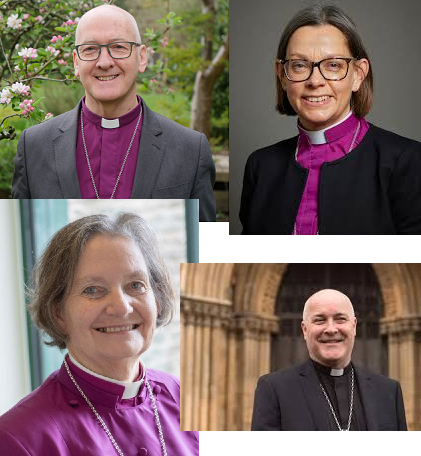
Five Bishops responded to the Kings Speech last week. The contributions on Thursday, the 2nd Day came from Bishop Alan Smith the Bishop of St Albans and Dr Guli Francis-Dehqani the Bishop of Chelmsford which can be seen here. On Friday, the 3rd Day after the Kings speech, Sarah Mullally the Bishop of London, Steve Croft the Bishop of Oxford and Stephen Conway the Bishop of Lincoln spoke on Friday which can be seen here.
Then this week on Monday there were three more Bishops which are Leeds, Newcastle and Bristol. Their comments are below and the whole of the session is available here. Then on Tuesday the Archbishop of York has contributed which is listed below and the other contributions are seen here. All of their speeches are listed here.
Bishop of Leeds – Nick Baines
My Lords, I am not an economist, but I care deeply about the economy. I shall limit myself to a couple of observations, and I am sure that I can save a few minutes in the length of the debate.
First, I welcome the Minister and thank him for his illuminating and articulate speech. I admire the new Government’s ambitions, but I worry a bit that there is too much. Holding all this together in a coherent development framework will be challenging beyond words, but I wish the Government well in doing it.
I want to plead for honesty from the Government and a good communication strategy to explain to the rest of us in the country who are not economists how all this is going to be rolled out. When it fails—elements will fail for a host of reasons, not usually intentional—the Government must trust the electorate and tell us the truth. When timelines do not work and get delayed, trust us and tell us the truth so that we know what is going on. We need to be treated like adults. I understand the need to adhere to the fiscal rules, but the Government choose what those rules are, so if they have implications for the rest of us, that needs to be explained clearly in language that can be understood by people like me.
What I am glad about in the gracious Speech is that we seem to have a programme that takes long-termism seriously. I hope that can be stayed with during this very ambitious programme, where the immediate will sometimes compromise the longer term. We need long-term thinking. I speak as someone who lives in the north of England and who has to use transport north and south but also east and west. The problems that we have with rail were mentioned earlier. The amount of money that has been invested in London and the south is light years above what has been invested in the north so far. I wonder whether the northern powerhouse is turning into a northern small battery, but that is to be seen.
There are a number of issues in relation to employment that really impact us in the north. Universities—I am familiar with a number in west Yorkshire—are now struggling and making people redundant, because we do not have students coming in from abroad. I know that raises questions about the models for investing in students, but we can talk about creating employment at the same time as we are losing employment in significant areas. One of the factors involved in that is access to good communications, especially rail and road. I came to this House 10 years ago, and I remember saying at the time that only way effectively you can get from east to west and from west to east is along one road, the M62. There is nothing else. What happens to the north-east when the A66 is snowed under, I suspect even in the summer? The rail links are appalling, whatever investment has gone in. I now have to get my PA to book trains north-south to get down here, knowing that if my train is cancelled I can get the one before or the one after and still get here for what I need to be here for. That is terrible in a country like this.
What about the issues we have with water? The failed experiment of the past 40 years, where pockets of individuals have benefited from much of our privatised utilities, needs to be addressed. I read the other day—I cannot remember the numbers—that the CEO and the CFO of Yorkshire Water have received more than £500,000 in bonuses. I work in a business that does not quite understand bonuses, because I do not get a salary, I get a stipend, but I always thought that a bonus was there to reward going beyond what you are employed to do. So why are people getting bonuses for abject failure where the money goes into the pockets of shareholders at the expense of consumers? This is a moral issue as well as an economic issue. I hope that the Government will address this as they go forward.
So I come back to where I began and say that I admire the ambition, but we have to be careful that we do not lose it as we go.
Bishop of Newcastle – Helen-Ann Hartley
My Lords, I welcome the gracious Speech and the importance it places on economic growth. I congratulate the noble Lords, Lord Vallance and Lord Petitgas, on their excellent maiden speeches.
The Government’s bold articulation of fiscal reality, and the resistance to colluding with demands for short-term fixes, present a helpful foundation for next steps. One question is: when striving for growth, who will most feel its impact? The UK has some of the highest levels of geographic inequality in Europe. According to a survey conducted in 2022 by YouGov and the Resolution Foundation, 41% of those surveyed in the north-east felt that their region has generally declined in recent years—the highest out of any region in the UK. This feeling is not unfounded when real wages in half of the north-east’s local authorities are still below 2008 levels. The impact can be felt in take-home pay and on our high streets, and it is borne out in the investment decisions of businesses.
It is essential that the growth we strive for is for the UK in its entirety, with a particular focus on communities whose potential is not yet fully realised. I therefore welcome the emphasis this Government place on local economies, and I look forward to seeing increases in mayoral powers and local growth plans through the English devolution Bill. However, the responsibility of ensuring that everyone feels the benefits of growth should not rest solely with the Government but should be shared by us all. How can each sphere of society—businesses, charities and civic institutions—partner together so that the benefits of growth are felt more widely?
I would like to highlight the businesses and social enterprises that recognise that their success is bound up with the flourishing of the local communities that they serve. The Big River Bakery in the Shieldfield area of Newcastle is a terrific example of this very point; it is a bakery, shop, cafe, training space, and so much more—a sustainable commercial model partnering with external support, rooted in a deprived local community, and nurturing kindness and compassion in its mission to serve.
There is another bakery, founded in Newcastle in the 1950s. Today, that bakery can be found on high streets across the UK and took an 8.2% share of the UK’s food-to-go sales in 2023. I was one of the many who joined Greggs in celebrating National Sausage Roll Day last month by purchasing its limited-edition yard of sausage rolls. That is a lot of sausage rolls; other sausage roll makers are available. Greggs has experienced enormous growth as a business, but it continues to serve its communities, contributing a proportion of its profits towards the Greggs Foundation, which supports local community organisations and addresses issues of poverty and inequality by distributing upwards of £4 million in grants each year and establishing more than 800 breakfast clubs. An example of how profit and growth can be achieved, but through partnership, its impact goes further. How can our Government encourage greater partnership and social responsibility, so that more communities feel the benefits of growth?
It is clear that economic growth is the driving mission of this new Government. I believe that success will be measured by the fruits of growth. My hope is that we will work towards equitable and sustainable growth, achieved through partnership for the benefit of all.
Bishop of Bristol – Vivienne Faull
My Lords, it is a great pleasure to follow the noble Lords, Lord Howarth and Lord O’Neill, and to welcome and congratulate the noble Lord, Lord Vallance, and greet him as the granddaughter of a Cornish man and a Scilly woman, as my father rather cheekily determined it.
I preface my remarks by welcoming, in an adjunct to the gracious Speech, the Government’s proposal to renew the Lords Spiritual (Women) Act, and I should declare my interest as I am a Member who benefits from its current provisions. But it is on modern slavery that I wish to focus my remarks this evening as, in the labour exploitation that we have seen increasingly in the areas of agriculture, domestic work and social care, there is growth that we should not seek and indeed need to guard against. As your Lordships know, modern slavery is a crime which affects every community in the UK. It is not a niche issue. It is estimated that 130,000 people are held in modern slavery in our country today, and we are used to hearing about day-to-day transactions where there is exploitation in car washes, manicurists or, increasingly, in accessing social care.
I must start this debate with a belief in the inherent dignity of work and the right of all workers to receive fair payment for their labour, free from exploitation. I applaud the work of many Members of this House and the former Government for their genuine commitment to tackling this terrible crime. The 2015 Modern Slavery Act was by no means a perfect piece of legislation, but it signalled real political intent. We have a world-leading national referral mechanism which supports thousands of victims every year. I am proud of the progress that the UK has made but, while there is much to applaud, there have been concerning developments as well. The Nationality and Borders Act, the Illegal Migration Act and, most recently, the safety of Rwanda Act have all put victims of modern slavery at further risk. This is particularly true where migrant victims are imprisoned, often due to criminal exploitation, and can be subject to a public order disqualification. Can the Minister tell the House what the plans are for these various pieces of legislation as they affect migrant victims of modern slavery? If he cannot do so now, will he commit to do so in the future?
Alongside international trade in human beings is domestic exploitation of human beings, particularly through county lines, and I applaud the ambition to introduce a new offence for criminal exploitation of young people. The need for a clear definition of child criminal exploitation is something which I and many on these Benches supported before in this House. However, I am disappointed that modern slavery was not directly referenced at all in the gracious Speech.
Several noble Lords have mentioned shortages of labour in various sectors and, as many have said, nowhere is this more acute than in our social care sector to which we entrust the lives and well-being of some of the most vulnerable in our society. Last year, nearly one in 10 roles in adult social care stood vacant. There is clearly an acute need for a clear strategy to fill vacancies and deal with issues of recruitment and retention in the workforce. However, it is unacceptable that gaps in the social care sector have led to a rise in labour exploitation. We have recently seen reports that modern slavery is surging in this sector, with nearly one in five potential victims who calls the modern slavery helpline working in social care. Restricted, temporary work visas are creating the conditions for labour exploitation, especially as anyone on a health and care or skilled worker visa has just 60 days to obtain a new visa, during which time they have no access to public funds. To tackle exploitation, we should start by making work visas more flexible so that workers are not trapped in exploitative conditions.
Work must have dignity and give people purpose. I applaud the Government’s ambition to strengthen workers’ rights and will continue to seek reassurance that we will end the abhorrent practice of modern slavery for good.
Archbishop of York – Stephen Cottrell
My Lords, it is an honour to respond to the gracious Speech. I, along with others on these Benches, welcome the noble and learned Lord, Lord Hermer, the Attorney-General, and thank him for a really moving maiden speech—not least his desire that we listen to and respect one another and work consensually.
Like others, I want to focus on one thing, which is rebuilding trust in democracy itself. The turnout on 4 July was shockingly low. Research also shows a 13% gap in turnout between constituencies with the highest and lowest proportions of home ownership. Furthermore, an estimated 400,000 people were turned away at the polling station because they did not have the right ID. These are alarming statistics, and I look forward to the changes outlined in the Government’s manifesto that could start to address them, including reducing the voting age to 16.
It is the link to poverty that causes me the gravest concern. It shows that a large proportion of our population do not feel they have a stake in our national life, nor much of a future to look forward to, and therefore for them, voting just is not worth it. There are measures on poverty in the King’s Speech that I welcome, particularly the children’s well-being Bill and the plans for free breakfast clubs, but I must take this opportunity to join others in calling for the removal of the two-child limit to universal credit, because it is the biggest driver of rising child poverty and has a big impact on trust in our democracy.
I have often spoken about the power of devolution, not just to shift power away from the centre. Devolution shifts perspective, enables consensual politics to thrive and enables us to take a longer view. The recently established York and North Yorkshire Combined Authority, where I live and serve, is already starting to demonstrate the difference this can make for rural as well as urban communities. I therefore wholeheartedly welcome the establishment of a council of the nations and regions. Moreover, noble Lords will not be surprised to hear that we on these Benches also welcome the extension of the Lords Spiritual (Women) Act 2015.
The tone of the Government’s manifesto and what we heard from the noble and learned Lord today speaks about governance as service. This is so important for building trust in our democracy. No one meant it to happen, but there has been an erosion of respect for the rule of law, convention and the weighty responsibility to tell the truth. However, the nature of our uncodified constitution is that it relies as much on conventions that are derived from tradition as anything else. Therefore, it is up to us to respect each other, listen to each other, build consensus and work together. I want to take a lead from the noble and learned Lord and say that we can be part of this in the way we conduct our business in this House.
Yes, there are legitimate questions about the House itself. First, we are a scrutinising Chamber, offering wisdom and a balance of power. It is for this incoming Government and the Ministers appointed to this House to ensure that this role is properly understood. Secondly, we ought better to represent the breadth of the nation we serve: 24% of our membership have links to London and 22% to the south-east, but only 3% to the north-east. Thirdly—I do not know what we do about this, but perhaps the noble Lord, Lord Burns, will tell us in a moment—there are just too many of us, and that is not good for us. Fourthly, while we on these Benches value our particular role as Lords Spiritual, we think that other faith communities could be better represented as well. We believe that there needs to be a wide debate about the reform of this House, and we are confident that when this happens, the place of faith in public life will be seen to matter. We look forward very much to working with other Members across this House in addressing these issues.
Finally, I want to pay tribute to something it would be so easy to take for granted and that shows the underlying strength of our democracy, which needs to be rebuilt and renewed: the respectful and peaceful transition of power from one Government to another that we witnessed a couple of weeks ago. For me, that is a great sign of hope for what we can be at our best, working together for the common good.


 ianchisnall