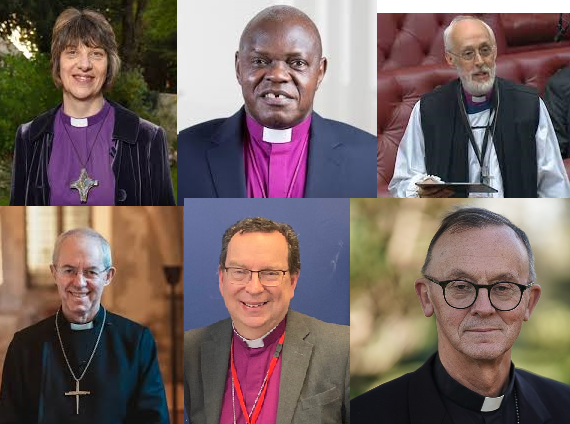
On Wednesday 24th July Rachel Treweek the Bishop of Gloucester, Lord Sentamu previously the Archbishop of York and David Walker the Bishop of Manchester made contributions in respect of the King Speech which is available here. On Thursday 25th July another group of Bishops were Justin Welby the Archbishop of Canterbury, Philip Mounstephen the Bishop of Winchester and finally John Inge the Bishop of Worcester spoke which is the final session here. All of these speeches are also listed here below.
Bishop of Gloucester – Rachel Treweek
My Lords, I congratulate the noble Lord, Lord Timpson, on his superb maiden speech, and I refer to my interest as stated in the register as Anglican bishop for prisons.
The gracious Speech began with the principles of
“security, fairness and opportunity for all”.
What does that mean for our criminal justice system? Much mention has been made of overcrowded prisons, an overflowing remand population and a void of rehabilitation leading to reoffending. In the past year I have convened cross-party, round-table discussions with key people in this and the other place, plus academics, those with lived experience and prison reformers. We are all agreed that we need a legislative definition of the purpose of imprisonment, and we need to improve the public’s understanding of sentencing. The concepts of punishment and vengeance are strong in the public narrative.
Beyond these doors, in the Prince’s Chamber, is the statue of Queen Victoria, positioned between the figures of Justice and Mercy. How would our criminal justice system be different if we allowed those two figures to properly dialogue? I recently visited the Netherlands, where there has been a huge reduction in the incarcerated population, not least through an imaginative rethink of sentencing, including different and appropriate care of those with mental health problems and addiction. Children are also dealt with differently, and I hope that in due course I will be able to share more of what I believe we could learn.
The narrative that our streets will be safer if we lock more people up and for longer is not supported by the evidence, and simply leads to doing more of the same thing. Just criticising the previous Government for not building more prisons is missing the point. A system that results in more imprisonment, continued repeat offending, more victims and no change in what is broken in lives and society is not only failing but is not cost effective. The government commitment to a
“justice system that puts victims first” not only requires tackling reoffending with a fresh look at appropriate education, rehabilitation and purposeful training in prison and beyond the gate. It also requires whole-system change, with a public health approach focusing on what will make for stronger and transformed communities, including tackling root causes. I am sure the Minister is aware of the Better Justice Partnership and its work on whole-system change, and I hope he might commit to meet with it.
Over decades, the inequality of our society has contributed to the warehousing of the vulnerable. We need a whole-community approach, and the issue of relationship is key. We need to look at the big picture, including up stream. We need that long-overdue review of sentencing. We need courage to establish alternatives to the revolving prison door and the repeated pattern of fractured relationship, and this must include community-based alternatives as well as the presumption against short sentences, not least with their disproportionate impact on women.
We need to properly resource, train and value prison and probation staff. More needs to be done with them, and for them—it is the big picture. The ambition of security, fairness and opportunity for all needs a large, articulated vision for the society and world we wish to see. Even our debate on the gracious Speech is siloed across government departments. We need to do join-up. It would be wonderful if we could start from a person-centred way of doing things. How about saying, “For a child born today, how will all that we do enable their flourishing into adulthood?”
But back to reality. I applaud the acknowledgement of children of prisoners. They also often serve a hidden sentence, so identification is long overdue. I am sure the Minister will connect with the charities Children Heard and Seen and the Prison Advice and Care Trust, which bring much expertise. I also applaud the intention to expand the remit of the Victims’ Commissioner and the ambition to halve the violence against women and girls—but that too requires looking up stream.
Time is ticking. Even if people are not driven by mercy in dialogue with justice, perhaps finance will be the driver. Prison costs just over £50,000 per person per year, and the annual social and economic cost of reoffending is estimated at £18 billion. A different and more effective approach means not higher cost but a redistribution of funds. As a Lord spiritual motivated by my faith in Jesus Christ and my belief in every person created in the image of God, I am hopeful about the opportunities that we have to transform the system, holding fast to those principles of security, fairness and opportunity for all.
Lord Sentamu – John Sentamu
My Lords, it is a pleasure to follow the noble Lord, Lord Dholakia. I begin my contribution to this debate on justice by calling Lord Bingham, a noble and learned Lord, as my expert witness. He is in glory. Thankfully, his incisive and illuminating legal mind speaks with authority on justice. He says at page 174 of his excellent book, The Rule of Law:
“The rule of law is … one of the greatest unifying factors, perhaps the greatest, the nearest we are likely to approach to a universal secular religion. It remains an ideal, but an ideal worth striving for, in the interests of good government and peace, at home and in the world at large”.
I humbly suggest to His Majesty’s Government that The Rule of Law should be the golden thread that runs through the legislative programme outlined in the King’s Speech, as well as in the governance of our four nations. It is the perfect glue that binds together governance and the laws passed by Parliament. The Attorney-General’s excellent maiden speech chimes in well with this, as does the maiden speech from the noble Lord, Lord Timpson. Bravo!
Take poverty, for example. President Nelson Mandela said:
“Overcoming poverty is not a gesture of charity. It is an act of justice. It is the protection of a fundamental human right, the right to dignity and a decent life. While poverty persists, there is no true freedom”.
Now then, what are we to understand by the rule of law, a phrase that we regularly use? My expert witness says the existing principle is
“that all persons and authorities within the state, whether public or private, should be bound and entitled to the benefit of laws publicly and prospectively promulgated and publicly administered in the courts”.
Further:
“State observance of the rule of law requires the availability of effective and impartial dispute resolution mechanisms. This means that citizens must be able to access the courts, and be heard by independent judges, under a fair process”.
A manifesto commitment to put victims first, supporting them at every stage of the criminal justice system, is a good innovation, but surely it must treat all alleged perpetrators of crimes as innocent until proven guilty, and therefore supported as well.
Building more prisons will ease overcrowding. However, as a former chaplain in the 1980s of a sizeable remand centre that was full beyond capacity most nights, I know that building new prisons must go hand in hand with increased funding for the courts system; legal aid; the rehabilitation and education of offenders; a fully funded and renewed Probation Service; a regular training review of all prison officers; a rigorous refreshing of the workings of the Crown Prosecution Service; and the renewal of restorative justice—
“To no one will we … deny or delay right or justice”.
The rule of law is not an arid legal doctrine but the foundation of a fair and just society, and a guarantee of responsible government. It makes an important contribution to economic growth, as well as offering the best means yet devised for securing peace and co-operation. My expert witness in The Rule of Law advocates eight conditions which capture its essence. I will give you four:
“The law must be accessible and so far as possible intelligible, clear and predictable … Means must be provided for resolving, without prohibitive cost or inordinate delay, bona fide civil disputes which the parties themselves are unable to resolve … Ministers and public officers at all levels must exercise the powers conferred on them in good faith, fairly, for the purpose for which the powers were conferred, without exceeding the limits of such powers”.
Finally, there must be
“compliance by the state with its obligations in international law”.
When it comes to justice, the rule of law guards, protects, drives and guarantees its delivery. Love without justice is self-indulgence. Justice without love is tyranny. The rule of law holds both justice and love together in a creative tension.
Bishop of Manchester – David Walker
My Lords, it is always a pleasure to follow my former boss.
As a trustee of the Clink Charity, where we help prisoners build skills for employment in the catering industry, I too welcome the noble Lord, Lord Timpson, and congratulate him on a powerful and hopeful speech. He might wish to know that the Clink restaurant at Styal prison won the Cheshire Life restaurant of the year award earlier this week. If his team can draw my remarks to his attention, I hope he will accept an invitation to dine with me there later this year, so he can see for himself. However, as my right reverend friend the Bishop of Gloucester has spoken eloquently about prisons already, I will focus elsewhere.
As co-chair of the national police ethics committee, I am deeply committed to the principles that Sir Robert Peel set out two centuries ago. Our police are civilians in uniform, not paramilitaries; they are servants of the Crown and society, not tools of government policy. Those distinctions have not always been clear in recent years, not least during the Covid pandemic. Hence, if we are to recover the levels of confidence in policing that Peel’s vision requires, visible neighbourhood policing and responding to every crime is vital. I welcome measures in the gracious Speech to those ends. I also welcome efforts to divert young people away from the criminal justice system at an early stage, and a focus on violence against women and girls.
One mark of a mature society is that it is willing to listen and learn when things have gone badly wrong. Hence, I am pleased to see proposals to extend the duty of candour. This, as the Minister has said, was a cornerstone of the report which the former Bishop of Liverpool produced in response to the Hillsborough tragedy. I will never forget meeting bereaved families at the stadium, as a young priest, seeking to offer such comfort as I could. I will also be supporting measures to improve safety at public events, and especially Martyn’s law, named, as we have heard today, after a victim of the Manchester Arena attack. I am grateful to the noble and learned Lord, Lord Stewart of Dirleton, who addressed the point about proportionality for voluntary and faith community venues in that regard.
Meanwhile, there are other past failings that we need to consider. I would be pleased to hear Ministers indicate how they wish to take forward the recommendations of the Independent Inquiry into Child Sexual Abuse. I would further urge His Majesty’s Government to set up the long-needed inquiry into the events that took place at the Orgreave coking plant during the miners’ strike—it was the parish next door to my own—so that we can guard against attempts to politicise policing in future.
I applaud the ending of the Rwanda scheme. Setting aside any moral concerns, I hope we will never again see a Bill before this House that the responsible Minister cannot confirm to be fully compliant with international law. Meanwhile, I and many others will continue to argue for safe and legal routes, so that genuine refugees who have firm reasons why Britain is the best place for them to begin rebuilding their traumatised lives can do so here. Given that refugee numbers remain a small fraction of net migration, I am confident that we can do this within the total migration numbers that Britain can absorb. Mindful of the skills that many refugees bring, I urge His Majesty’s Government to allow those who have spent months—or longer—waiting for a claim to be processed to contribute to our economy by taking paid employment.
On a wider matter, I welcome the commitment to ban conversion practices. I welcomed its appearance in the previous Government’s programme, not long after the Church of England General Synod had called by a huge majority for such a ban. Progress stalled, of course. I have met too many people suffering lifelong damage from such abuse. I and others stand ready to help frame a law that will outlaw these disgraceful practices while not criminalising medical practitioners and registered therapists, or private non-coercive prayer.
Finally, I am delighted to be followed today by the noble Lord, Lord Goodman of Wycombe, who will make his maiden speech. I remember, during my time as Bishop of Dudley, when he was in the other place, he came to visit my diocese. I was so impressed by his work supporting faith communities. I look forward to the significant contributions that he will make to your Lordships’ House, both immediately following my speech and in times to come.
The Archbishop of Canterbury – Justin Welby
My Lords, I join noble Lords in congratulating the noble Lord, Lord Coaker, and the noble Baroness, Lady Anderson, on their appointments and on their party’s first King’s Speech. As a successor to the noble Lord, Lord Ahmad, the noble Baroness has a very hard act to follow indeed, as I am sure the whole House will recognise. I also congratulate the noble Baroness, Lady Goldie, on her remarkable meal, which, as I missed breakfast, may result in me leaving quickly to have lunch—but it will not be as good.
As others have indicated, we are living in unstable times. The Anglican Communion, in 165 countries, finds almost half our members facing conflict. Issues elsewhere in the world, however, do not confine themselves to affecting us in our international policy alone. We are recognised now by the United Nations as the most diverse nation on earth. That means that every single overseas conflict or disaster has a diaspora community here. To build a cohesive society here, domestic and foreign policy must work hand in glove.
That is seen with Israel and Gaza. Conflict overseas has a profound impact on our own society and our own domestic policies because of the multicultural nature of our communities. Interfaith dialogue in this country has almost collapsed since 7 October last year and tensions are high, and that is entirely as a result of overseas matters.
The interplay is also clear in our response to questions of mass migration and climate change. Domestic challenges require cross-border solutions if they are to be effective. I ask the noble Lord, Lord Coaker, what structures there will be in government to ensure that co-ordination.
I welcome the Government’s approach and intentions for foreign policy expressed so far, including their commitment to ongoing support for Ukraine, calling for a ceasefire in Gaza, a two-state solution, and upholding international law and investing in international co-operation and institutions. I welcome the strategic defence review, with its aims of reinvestment in our Armed Forces, in their effectiveness and—as was just mentioned by the noble Baroness, Lady Smith—in their well-being.
Noble Lords will know that the Foreign, Commonwealth and Development Office houses the pithily named negotiations and peace processes team in the Office for Conflict, Stabilisation and Mediation, established by the Conservative Government by the noble Earl, Lord Howe. It has been enormously effective. The cost—financial, human and every other—of trying to prevent conflict is far smaller than the cost of war once it has broken out. It can happen in many places where we would never intervene militarily but where our interests are deeply at stake. Further investment in making peace should be considered alongside the necessary and urgent increase in spending on our military force. Both are insurance premia, and they need paying. Peacebuilding in the DRC, for example, where China and Wagner are active, and which is the worst area for sexual violence in conflict, is also essential for the world’s green ambitions.
Secondly—I am beginning to wind up—it is essential that our foreign policy is religiously literate. Some 85% of the world’s population identifies with a faith. To engage with foreign policy without doing so is madness. I welcome the intention, for example, to develop a strategy for Africa. However, to do so without consideration of religious faith makes absolutely no sense at all.
The Labour manifesto said:
“Government is at its best when working in partnership with business, trade unions, civil society, faith groups, and communities. But without a shared project those partnerships barely get off the ground”.
In Mozambique, Anglicans, in partnership with the UN, have played a significant part in building groups to undermine the hold of ISIS in Cabo Delgado. There are innumerable faith groups and NGOs that will wish to deploy their ability and local knowledge similarly. We look forward to working with this Government as with the last.
The Bishop of Winchester – Philip Mounstephen
My Lords, I am grateful for the noble Baroness’s remarks at the start and am pleased that the Government have expressed a desire to reset the UK’s international relations. If the UK is to exercise the soft power that we undoubtedly might, not least through proper investment in the BBC World Service, it is vital that we are as fully engaged internationally as we can be. In that regard, I stress the vital importance of freedom of religion or belief—or FoRB for short, because it is a mouthful—in today’s world. It is a vital human right, and its increasing abuse is a growing global threat.
At a purely human level, consider some of the grave impacts of FoRB violations. Victims of religious persecution often experience severe psychological trauma. Constant fear and stress undermine both community well-being and personal health. Children who witness or experience such violence are affected throughout their lives, perpetuating cycles of trauma and fear. Women are particularly vulnerable in contexts of religious persecution, often facing sexual violence and multiple forms of exploitation, including people trafficking, forced conversion, and forced marriage—or rape by another name.
FoRB violations are a significant driver of displacement. Millions are forced to flee their homes to escape persecution, leading to immense humanitarian challenges. It would be good to know whether the Government’s latest initiatives in this area of migration recognise and address the violation of freedom of religion or belief as a significant factor driving migration. If not, they should. There is a link, too, with climate change. The past decade has seen a significant rise in both CO2 emissions and persecution in the world’s two most populous countries: India and China. I suggest that that is no coincidence. I am not suggesting there is a causal relationship between the two, but I do suggest there is a moral relationship.
So this is not a side issue. In that regard, I am glad to see the reappearance of the Holocaust Memorial Bill, even as I recognise the sensitivity of the issue of the memorial’s siting. The Holocaust remains an appalling reminder of the grave danger of abandoning the freedom of religion or belief.
Yet this right is under increasing threat today. Its biggest threat comes from overbearing, authoritarian and nationalistic Governments bolstered by their own particular ideology or, indeed, theology. Putin’s regime in Russia is bolstered by “Russkiy mir”—meaning “Russian world” or, ironically, “Russian peace”—a theology shamefully expounded by the Russian Orthodox Church and roundly criticised elsewhere in Orthodoxy. President Xi’s ambitions for Chinese hegemony are bolstered by the ancient concept of tianxia—literally, “all under heaven”—a geopolitical system with China at the centre and Xi at the centre of the centre.
Iran’s leaders are motivated by an apocalyptic belief in the revelation of the 12th imam, a belief that feeds their violent repression at home and their violent activities abroad. In India, those close to President Modi expound and espouse the concept of “Akhand Bharat”—unbroken India, stretching from Afghanistan to Myanmar, encompassing Pakistan, Bangladesh, Sri Lanka and Nepal, and bolstered by Hindu fundamentalist theology. That is very bad news for the vast numbers of non-Hindu minorities within the greater whole. Indeed, all these theologies are bad news for minorities of every sort, and bad news therefore for the wider world. So the time for inaction and indifference is over.
Happily, the UK has a growing international reputation and role in this area. Following the Truro review, which I was honoured to author, and the changes to government policy it brought about, we have established the UK FoRB Forum, which gathers around 90 civil society actors to make common cause on this issue. Two years ago, the UK hosted a successful international ministerial conference on the issue and, last year, the UK co-sponsored for the first time a UN Security Council resolution on it.
Fiona Bruce, until recently MP for Congleton, held the role of the Prime Minister’s special envoy on this subject with great energy and commitment and, as such, chaired the growing intergovernmental International Religious Freedom or Belief Alliance, of which the UK is a founder member.
I therefore encourage the Government to build on this foundation and take a faith-literate approach to foreign affairs. Looking at the world of today through western secular lenses will not do and simply makes us increasingly vulnerable. I encourage the Government to make a fresh and speedy appointment of a special envoy for freedom of religion or belief; it is much needed. I have no doubt that embedding FoRB at the heart of foreign policy and appointing a special envoy will simply mean that we are more effective actors globally. In today’s world, we cannot afford to be anything less.
The Bishop of Worcester – John Inge
My Lords, I join others in welcoming the Ministers to the Front Bench and begin this valedictory speech by saying what a privilege it has been to serve in your Lordships’ House for the last 12 years. I thank all noble Lords and staff on the estate for all they do and their hard work.
After my maiden speech, a fellow Peer asked me how it had gone. “Oh, they were very nice and kind”, I responded. “Yes”, he retorted; “I have never known a place where courtesy is used as such an effective weapon”. I have experienced much unweaponised courtesy and civility here. I have consistently encountered humanity at its best, and I thank your Lordships, whatever their political affiliation, for their impressive devotion to the common good.
In this final intervention, I will concentrate my brief remarks on development issues, which have been a passion of mine throughout my adult life. While I recognise the imperative for defence spending and the need to be ready for war, I hope that the Government will pay equal attention to development, which is an indispensable contributor to peace and human flourishing.
I welcome the Government’s stated commitment to international development. I note that the manifesto spoke of a new mission statement for international development
“to create a world free from poverty on a liveable planet”.
I applaud this and know that all on these Benches will want to work with the new Government in delivering that mission.
The manifesto also stated:
“Government is at its best when working in partnership with business, trade unions, civil society, faith groups, and communities”.
I observe, partly as a result of my first-hand experience in Africa, the Indian subcontinent and South America, that there is scope for much better partnerships with Church and Church-related networks internationally, especially in the field of humanitarian relief and poverty alleviation. Developing the potential of such partnerships, as the most reverend Primate the Archbishop of Canterbury reminded us earlier, is dependent on the Government achieving a religiously literate international development policy and awareness of the role that transnational religious actors play in international affairs.
This is especially true when it comes to the Government’s plans to publish a new strategy for Africa. An Africa strategy that does not recognise the importance of faith and religion would be short-sighted in the extreme. I am delighted by the appointment of the noble Lord, Lord Collins, to his new post as Minister for Africa, which I imagine he will take very seriously indeed.
The international situation with respect to debt is dire. As Christian Aid highlighted recently in its report, Between Life and Debt, 32 African countries spend more in paying external debts than on healthcare, and 25 spend more on external debts than on education. It is clear that, without addressing today’s debt crisis, lower-income countries will not deal with the impacts of the climate crisis or have any hope of meeting the sustainable development goals.
The UK Government are well placed to play a significant part in addressing this crisis, because the majority of external debts owed to private creditors by countries in debt distress are governed by English law. I therefore welcome the manifesto pledge on tackling unsustainable debt. To put this pledge into action, I suggest that the new Government could commit to UK legislation to incentivise private creditors to participate fully in multilateral debt relief initiatives. Coming at no cost to the taxpayer, this would be a practical and realistic step that could be taken quickly to unlock the impasse in global debt relief and release serious resources.
I would love to see the new Government return to spending 0.7% of GNI on development as soon as possible, but in the meantime I implore the Government to ensure that aid is spent in lower-income countries, not in the UK. At present, more than half of UK bilateral aid is spent in the UK, mostly on asylum seekers, which is surely not an appropriate use of the aid budget. I also implore the Government to ensure that aid is refocused squarely on tackling poverty and its causes. That would include investing in the prevention of humanitarian crises and putting resources in the hands of local organisations.
I note that the Foreign Secretary has spoken often of the need for the UK to become a leader in development by adopting a model that emphasises trading with other countries to build long-term win-win partnerships, rather than following an outdated model of patronage. I agree. Such actions are in our own interest, as well as that of other countries. As a Christian, I believe that they are also a moral imperative. Jesus tells us to love our neighbour as ourselves, implying that it is in loving our neighbour, wherever they may be in our global village, that we properly love ourselves. That insight has always been at the heart of all that is best in British values. I pray that it may remain so. As I sit down, I offer the assurance of my prayers for your Lordships’ House.


 ianchisnall
Pingback: Bishop of Manchester asks Question for Universal Credit | ianchisnall