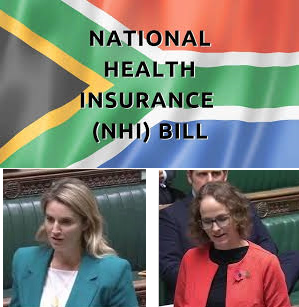
At the beginning of last week there were three very significant votes. The first, ‘Elections (Proportional Representation)’ with 135 MPs approving and 132 opposing. The other, ‘National Insurance Contributions Bill’ referred to as ‘:Reasoned Amendment to Second Reading’ which was approved by Conservative, Liberal Democrat, SNP, DUP, Plaid Cymruachieving 186 votes The Labour Party voted it out with 329 votes. The called ‘:Second Reading’ was approved by Labour 332 passed but the people who opposed it were Conservative, Liberal Democrat, SNP, DUP, Plaid Cymru and also Green’s with 187 votes in all. Andrew Griffith and Alison Griffiths did not vote at all that day and James MacCleary of Lib Dems only voted for the Proportional Representation.
Jessica Brown-Fuller spoke to the National Insurance Bill: “First, I would like to acknowledge the Labour Government’s inheritance from the previous Government, and recognise that tough decisions need to be made to rebuild public services. The Liberal Democrats welcome the proposed increase to employment allowance, but the blanket increase in the rate of secondary class 1 contributions across all sectors is going to make things harder for GPs, social care providers, charities and local authorities in my constituency and across the country. Those sectors have had a tough time for years, struggling with rising energy costs and higher interest rates, with thousands of care providers on the brink of bankruptcy, NHS dentists already delivering some NHS treatments at a financial loss, and charities already grappling with underfunded public sector contracts
….The Government’s treatment of GPs as private entities excludes them from the employment allowance support, and if we do not fix the front and the back door of our national health service, the middle—our secondary care, our hospitals—will continue to bear the burden.
St Wilfrid’s hospice echoes these challenges, citing the inequity in exemptions being granted to NHS services, but not to charities providing similar health-related services. The hospice predicts a bill increase of £175,000. That would pay for four nurses, who could be out in the community providing care for the most vulnerable. The predicted national impact of this rise on the charitable sector is £1.4 billion…..
The Secretary of State for Health and Social Care talked of moving the health model in this country from treatment to prevention and from hospital to community, but the increase in NICs directly undermines the ability to do that, if GPs have to reduce their services, if more dentists move further away from NHS contracts, if social care staff lose their jobs when their small and medium-sized care providers go bankrupt, and if community pharmacies, a key pillar in the NHS ecosystem, face spiralling debt and struggle to keep pace with operating costs.
In the interests of constructive opposition, I am not minded to bring problems without solutions. The Chancellor could have chosen to raise the money needed through the much fairer tax changes laid out in the Liberal Democrat manifesto during the general election, such as the reversal of the Conservative tax cuts for the big banks, doubling the rate of gaming duty paid by online gambling services or a fairer reform of capital gains tax….”
Alison Bennett, Liberal Democrat spokes: “On Saturday evening, I was lucky to attend Sussex Chorus’s performance of Handel’s “Messiah” at St Andrew’s church in Burgess Hill. There was a collection at the end for the St Peter and St James hospice, which looks after many people in Mid Sussex. As I put my donation in the bucket, the lady holding the bucket thanked me, and she told me that her husband had spent his last days at St Peter and St James. When she realised that I was the local MP, she grasped my hand tightly, and said, “You have to do something about NICs.” I said that I had been trying to, and had been raising the matter in the Houses of Parliament, but having not been heard so far, I will raise it again today.
Our hospices and social care providers do hugely difficult, often invisible work. They look after the weak, the vulnerable and the dying, but these organisations are themselves even more vulnerable than they were as a result of the Government’s proposed changes to employer national insurance contributions, announced in the Budget…. The children’s hospice charity Together for Short Lives estimates that the rise from 13.8% to 15% in April 2025 that was announced in the Budget will increase costs for children’s hospices, which provide lifeline care to seriously ill children, by nearly £5 million annually
….In the social care sector, MHA, supports more than 17,000 older people across 80 care homes, 59 retirement communities, and 43 community-based hubs, estimates an additional £4.6 million in costs in the first year alone.”
Alison Bennett spoke later “….Around 18,000 private social care providers operate in the UK. We must help them to help those in need…. How can we expect those providers to survive if we impose higher taxes on them? This is not making the most of an opportunity for long-term positive change;… My Liberal Democrat colleagues and I have repeatedly urged the Government to exempt social care providers and hospices from the tax rise, and I do so once again today. Let us do right by those who work tirelessly to support and protect our most vulnerable, and in doing so, let us build a healthcare system fit for the future”


 ianchisnall