In the days leading up to the holiday period in Parliament two e-Petitions were arranged for the 16th December “Israel and Palestine” with 653509 “For the United Kingdom to recognise the state of Palestine immediately” with 283,669 signatures and item 652949 “Immediately revoke all licences for arms exports to Israel” with 107,316 signatures. Sadly, No Sussex MPs have contributed to the debate.
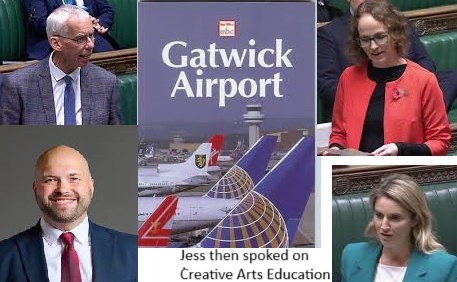
On the 18th December John Milne, Liberal Democrat MP for Horsham, debated the Gatwick Airspace Modernisation Review, joined by Alison Bennett, Liberal Democrat MP for Mid Sussex and Peter Lamb, Labour MP for Crawley.
John began “I have brought today’s debate in order to represent growing concerns from residents regarding the airspace modernisation process around Gatwick, which is part of the future airspace strategy implementation south, known as FASI-S. Before I start, I would like to make it clear that I wholly support the modernisation process in principle. It is a vital step if we are to improve the efficiency of civil aviation, cut flight times and reduce carbon emissions…. The process as it stands involves a significant conflict of interest. I would also like to emphasise that the airspace modernisation process is entirely separate from the second runway application at Gatwick, although it is going on at the same time and naturally gets confused in the public mind. The airspace modernisation process will go ahead whether or not Gatwick obtains permission to expand and is in fact part of a national process also being conducted at 19 other airports across the UK”.
Alison added “I have been concerned for some time about potential expansion at Gatwick airport, in particular bringing the emergency runway into commercial use. Does my hon. Friend agree that should the decision be approved, the problems he outlines will only be exacerbated?”
John responded “Indeed, there is a suspicion that part of the motive behind this is to enable an expansion, which has not been permitted yet. In this new design, flights would be concentrated over a much narrower band of countryside”.
Peter Lamb commented: “in 2014 I was on Gatwick’s consultative forum as a community representative and I was well aware then of the impact that the trial route had, in terms of concentrated noise in some areas and the consequent storm of community feeling….., one of the key problems will ultimately be that if we are trying to rationalise airspace with a complex set of interconnecting airports, there will only be a finite number of routes that can reasonably be taken…..My broader concern is that….. ultimately what we are doing is enabling far greater capacity in terms of flights in our region. As I am sure both the hon. Member and Alison Bennett will agree, north Sussex’s infrastructure is already completely overloaded from dealing with the existing levels of demand from the airport and the associated industries. Any growth in capacity will require someone—either the airport or the Government—to step in and significantly invest in our communities to make sure that they do not suffer the ill effects of far greater levels of aviation in our region.”
John Milne responded: “Indeed, part of the problem is that this process is in isolation from 100 other issues; infrastructure is very much one of them, because, as he says, it is already sadly lacking….. the options show little to no variation from each other. It is not three choices; it is one choice repeated three times. Without sight of a genuine alternative that builds on the structure already in place—using routes that already bear traffic—how can the public understand the trade-offs of different pathways? It is worth noting that Heathrow has three clearly varying pathways, which differ in direction and geometric shape from each other, for the public to consider”.
Jess Brown-Fuller then spoked on Creative Arts Education
“It is a pleasure to open this debate…. I refer Members to my entry in the Register of Members’ Financial Interests, both as chair of the all-party parliamentary group on performing arts education and training and as trustee of Chichester Festival Theatre…. The arts and cultural sector contribute well over £8 billion to the UK economy each year. It puts £2.5 billion directly into the Treasury through taxation, and the creative industries as a whole generated £125 billion in 2022. They account for almost 6% of the UK economy, create 2.5 million jobs and have a huge impact on the tourism economy, with one in 10 tourists to the UK visiting a theatre. Theatres sell 34 million tickets a year across the UK…. I had a fantastic time as the guest judge at the Priory Park pantomime, and…. I will be off to enjoy the Chichester Festival Youth Theatre’s production of “Cinderella”—a professional production on the main stage—with my family…. After studying drama at GCSE and A-level, I went on to the University of Chichester and obtained a degree in performing arts. Before this giddy world of politics ensnared me, I had the privilege of teaching the next generation performing arts at various organisations and in schools. I am living proof that a creative education can lead anywhere, including to this place….I thank hon. Members, the shadow minister and the Shadow Minister for talking about the importance of creative arts education and how it will foster the next generation of well-rounded and emotionally intelligent young people, who can thrive”


 ianchisnall