MP grills Chancellor in the run-up to the Budget


During this week MPs are not based in Parliament because of a planned Government Recess from the end of last Thursday opening again on Monday 19th February.  However, the House of Lords will hold their own discussions for three days this week. Today there several events which include “School capacity to identify and implement a plan of support for special educational needs” and also “Safety of Rwanda (Asylum and Immigration) Bill”. It would be good to get information from our House of Lords members that are connected in Sussex.

Last week on Monday the proposed e-petition item “e-petition 608237 relating to prescription charges for people with chronic or long-term health conditions” organised by Tonia Antoniazzi did not take place at all.  There is no information about why the petition did not get an airing. However last Tuesday the Conservative MP, Pauline Latham from Mid Derbyshire introduced an unplanned e-petition session that was not announced on the ‘TheyWorkForYou’ website. It was set out as “Homes for Ukraine Scheme: Potential Extension” in two parts. They were “e-petition 642280, Provide Ukrainian refugees with settled status to enable a stable life in the UK” and “e-petition 632761, Give Ukrainians on humanitarian visas rights to extend stay and settle in the UK”. The first one had about 35,000 signatures but there is another month for it to finish. There were signatures across Sussex and the second which finished six months ago only has 20,659 signatures and it was also supported from all over Sussex. Sadly, although there were about thirteen MPs that took place in the discussion, none came from Sussex.

On Monday there were three votes for the Finance Bill, clause 6 – “Assessment of the impact of permanent full expensing” and Clause 7 – “Review of multipliers used to calculate higher rates of air passenger duty” The third item, Schedule 6, – “Administration of creative sector reliefs”. The clauses were rejected by the Government and endorsed by Labour and a number of other Political parties. The Schedule was endorsed by the Government and only opposed by the SNP and Liberal Democrats. Most of the Sussex Conservatives MPs endorsed both the clauses and the Schedule. However, Huw Merriman only endorsed the Schedule and did not oppose the two Clauses and Jeremy Quin and Henry Smith did not vote for any of them. Lloyd Russell-Moyle voted in favour of the two Clauses but he ignored the Schedule item. Peter Kyle and Caroline Lucas did not vote on any of the Finance Bill items.

On Tuesday there was a vote that took place entitled “Miscellaneous” promoted by Labour, SNP, Liberal Democrat and Plaid Cymru parties. The debate before the vote included Lloyd, who stated in the early part of the discussion with

“My right hon. Friend has mentioned many Secretaries of State. We also had a short-lived Prime Minister, who is entitled to some payments for the rest of her life. Should we not also look at whether it is appropriate for people who leave in disgrace to end up with lifelong pay cheques?”

After the discussion he voted in favour of the item but neither Peter Kyle or Caroline Lucas voted for it. Most of the Sussex Conservative MPs voted against it and so the event was not opposed.  The only two Sussex Conservatives that did not vote either way were Jeremy Quin and Henry Smith. 

Further on Tuesday two other Sussex MPs participated in discussions.  Caroline Lucas spoke on the Topical Questions that was managed by Jeremy Hunt the government minister. Caroline opened her comment

“Last week, the International Monetary Fund joined many others in urging the Chancellor to prioritise public spending and investment above tax cuts. Rather than seeking to appease his Back Benchers with tax cuts in the next Budget, will he finally deliver the level of public investment this country is crying out for, including in a nationwide energy efficiency programme that would shield households from volatile gas prices, get their fuel bills down for the long term and create jobs? Or is he yet another one who is running scared of green investment?”

Jeremy responded with

“I am sure the hon. Lady understands that I cannot talk about what will be in the Budget ahead of the Budget because no decisions have been made. I celebrate with her that the UK recently became the first major economy in the world to decarbonise by more than 50%, ahead of France, Germany, Japan and the United States.”

Last Tuesday Sally-Ann Hart spoke on the “Knife and Sword Ban” debate. Her first comment was

“On tougher sentences—I know that the Government are bringing in very tough sentences for knife crime—does my hon. and learned Friend agree that it is not just about tough sentences? Knife crime is due to a number of factors, including socioeconomic factors, gang activity, the county lines drug trade, which affects us in Hastings and Rye, and social media influence. Does he agree that building trust between communities and law enforcement is as important as effective community policing and tough sentences, and that as part of that building of trust, raising awareness about knife crime and educating young people about the risks can deter them from carrying weapons?”

Such significant subject matters deserve the attention of all of our MP’s. It is important to observe comments three Sussex MPs and to identify which voted and which did not.


Posted in Parliament and Democracy | Tagged , , , , , , , , | Leave a comment

An MP suggests Devon and Cornwall is similar to Sussex


On Wednesday last week on 7th February, the Conservative MP for Hastings and Rye, Sally-Ann Hart took part in the discussion for Police Grant Report and she suggests that “The situation in Devon and Cornwall is similar to that in Sussex”. Her comment was responded by Steve Double who is the Conservative MP for St Austell and Newquay and he had spoken first before Sally-Ann responded. Here is her comment and his following first few words:

Sally-Ann Hart: The situation in Devon and Cornwall is similar to that in Sussex, where an influx of people to Camber Sands can mean that there are 25,000 people on the beach. That obviously makes police resourcing difficult. Does my hon. Friend agree that, when it comes to police funding, we need to consider the geography of the area and the specific and absolute need, not the relative need?

Steve Double: My hon. Friend makes precisely the point that I was about to make. In Devon and Cornwall, our geography and the number of tourists we welcome every year mean that our police force faces a unique challenge in delivering the service that we require of them.

Posted in Parliament and Democracy, Policing | Tagged , | Leave a comment

Are taxpayers being scammed by the Archbishop?


A few days ago during the Engagements for the Prime Minister in Parliament, Tim Loughton the MP for East Worthing and Shoreham asked a very challenging question and the Prime Minister responded. The text for these items can be obtained from here which relates to the Archbishop of Canterbury.

Tim Loughton: The thoughts of the people of East Worthing and Shoreham are with His Majesty, too.

The Archbishop of Canterbury has admitted that, since taking office, attendance at the Church of England has dropped by 15%. In the 10 years to covid, the number of baptisms in the Church of England has fallen from 140,000 a year to 87,000, so Christianity in the UK seems to be on the wane, unless, apparently, you are from a Muslim country in the middle of an asylum claim. We are now told that one in seven occupants of the Bibby Stockholm has suddenly become a practising Christian. Given that the Church of England has now issued secret guidance to clergy supporting asylum applications for these Damascene conversions, to whom is the Church accountable? Are taxpayers being scammed by the Archbishop?

Rishi Sunak: When it comes to illegal migrants, we need to have a system whereby, if someone comes here illegally, they should not be able to stay. My right hon. Friend the Home Secretary has asked for more information about the extent to which migrants converting to Christianity is playing a role in our asylum system. More generally, under our Illegal Migration Act 2023, anybody entering the UK illegally will not be granted asylum here. That is why we need to have somewhere to send them and why our Rwanda scheme is so important. The Labour party has blocked these measures every single step of the way, because it does not have a plan and it will not keep Britain safe.

Posted in Parliament and Democracy | Tagged , , | Leave a comment

The Government are refusing to review children’s meals?


On Tuesday in House of Lords there was a discussion entitled Premature Deaths: Heart and Circulatory Conditions that was set out by Gillian Merron who is a Labour member and her initial question was “To ask His Majesty’s Government what assessment they have made of the increasing numbers of premature deaths from heart and circulatory conditions since 2020.” and the Government Minister Nick Markham responded initially as below. However later on in the discussion there was a significant question from Clive Brooke who is also a Labour member and he asked his question focused on “why the Government are refusing to review the regulations governing children’s meals?” and that was also responded by Nick Markham. The full range of events can be obtained from here.

Nick Markham to Gillian’s first question: The Government are committed to reducing premature deaths from cardiovascular disease. The NHS long-term plan aims to prevent 150,000 heart attacks, strokes and dementia cases by 2029, as well as preventing up to 23,000 premature deaths and 50,000 acute admissions over 10 years. The major conditions strategy will look at how best to tackle the key drivers of ill health and increase the healthy years of life for people with major conditions such as cardiovascular disease.

Clive Brooke: Can the Minister say why the Government are refusing to review the regulations governing children’s meals? We know that the sugar content in them is too high and that our children are eating too much sugar. This needs to change, yet the Government refuse to look at the regulations and enforce them properly.

Nick Markham: I am not quite sure that I agree with the word “refuse”, but I agree with the noble Lord that healthy food in all environments is a good thing. I know that the delay happened because it was originally planned for 2020 or 2021, I think, and then the pandemic got in the way. I freely accept that the review now needs to take place. We are not refusing to do it, because it is an important part of the armoury.

Posted in Education, Parliament and Democracy, Youth Issues | Tagged , , | Leave a comment

Jo Gideon says that FareShare, is essential for food


On last Thursday on the 1st February there was a session in the Parliament for MPs to raise questions with Penny Mordaunt who is the leader of the House of Commons and apparently he is also the Madam Deputy Speaker. One of the MPs that raised it was Jo Gideon who is the Conservative MP for Stoke-On-Trent and she asked this question and Penny answered on here and below.

Jo: A very happy birthday to you, Madam Deputy Speaker. Food waste is bad for the environment and bad for the economy, which is why the work of food redistribution charities, such as FareShare, is essential. At a time when people are struggling with the cost of living, the redistribution network is vital. We should look at how we can improve it and invest in it. Although the Government are making good progress in reducing food waste along the supply chain, there is still much more that can be done. Even in this House, I am always concerned about how much food we throw away. Will my right hon. Friend make parliamentary time available to discuss the issue of food waste in the UK?

Penny: I thank my hon. Friend for raising that very important matter. I know that many right hon. and hon. Members from across the House are involved in pantry and larder schemes, which not only help people with the cost of living but ensure that food does not go to waste. These national networks are quite often tied in with local provision as well—with local allotments and community groups. I think that is an excellent topic for a debate, and I know that the Backbench Business Committee Chairman will be interested in an application.

Posted in Parliament and Democracy | Tagged , , , | Leave a comment

MPs debate prescription charges in the Commons


This week includes an important subject matter in a session this afternoon organised by Tonia Antoniazzi the MP for Gower in South Wales “e-petition 608237 relating to prescription charges for people with chronic or long-term health conditions” The e-Petition was entitled “Free prescriptions for those with a long term and/or chronic condition.” So far, this petition has collected 20,258 signatures. 1,000 signatures of this figure came from Sussex with the largest area for signatures being Brighton and Hove. There were more signatures in Brighton Pavilion than anywhere else in the UK. The petition includes the initial comments;

We recognise the impact of chronic illness. 89% of prescription items dispensed in the community in England have no charge. Those not exempt may save money with a prescription prepayment certificate. The Government understands the immense challenges faced by those living with chronic or long-term conditions, often having to limit their lifestyles through no choice of their own, as well as the impact on their loved ones. We recognise that many patients with these conditions may need many prescription items to manage their health needs. While not everyone qualifies for free NHS prescriptions there are a broad range of NHS prescription charge exemptions in place in England to help those patients with the greatest need, to ensure that prescriptions are affordable.

On Tuesday one of the Committee’s taking place is the Education Committee which involves Caroline Ansell. The discussion is about the “Impact of industrial action on university students” This relates to a session that took place in November;

Universities marking boycott’s impact on students – Education Committee launches new inquiry” they go on to state “The Education Committee has launched a new inquiry to investigate the impact that this year’s industrial action by university staff had on students.

On the same day as the event involving Caroline a session in the House of Lords organised by a Green Peer member called Baroness Jones of Moulsecoomb. The session is “Additional government measures in response to Met Office belief that 2023 was the second hottest year on record” so it will be interesting to find out what Jenny Jones will contribute tomorrow. These two items appear to be the only listed discussions available on the Government website for this week. Last week’s e-petition “Call an immediate general election” was noticed by only a very few MPs and none from Sussex.

During January there were a total of thirty six votes and nearly all of them were determined by the Government but some of the Government items were proposed by the Labour Party. However, there were a couple of unusual voting patterns last month. Back on the 16th January there were a number of votes which were about the Safety of Rwanda Bill and all of the Sussex MPs participated in the vote. However, there was also a session organised by the SNP entitled “Scotland (Self-Determination)” and apart from the SNP the others who voted were the Plaid Cymru and Caroline Lucas and one Conservative MP so only forty-eight MPs. There were two hundred and twenty-six MPs that rejected it most of which were Labour MPs and only a few Conservatives some Liberal Democrats and the DUP. Most of the Sussex MPs did not contribute at all but Tim Loughton from East Worthing and Shoreham, Sally-Ann Hart from Hastings and Rye and Lloyd Russell-Moyle from Brighton Kemptown did oppose the SNP idea of self-determination.

A few days later on the 23rd January there was initially a so called ‘Miscellaneous’ event and nearly all of the Sussex MPs voted for that item apart from Caroline Ansell from Eastbourne and Peter Kyle from Hove. After that event there was another vote introduced which did actually get submitted by the Labour Party. It was called “Protecting Steel in the UK” and along with the Labour Party which included Lloyd Russell Moyle the Labour MP for Brighton and Caroline Lucas for the Green Party there was also SNP, Liberal Democrats, DUPs and Plaid Cymru MPs. It was significant because 224 MPs voted with literally no MPs voting against it.

The opening discussion was began with Jonathan Reynolds who is the Labour MP for Staylbridge and Hyde and he stated amongst other words he stated

I beg to move, That this House recognises the need to decarbonise steel production; appreciates the pride that local communities have in their historic steelworks; regrets that the Government has pushed through plans for decarbonising steel in the UK which will result in thousands of steelworkers losing their jobs and risk leaving the UK as the first developed country in the world without the capacity to produce primary steel

Along with Jonathan and many other people who did speak prior to the vote the Government introduced a Minister who was Nusrat Ghani, the MP for Wealden. She spoke fifteen times and her first comment began with

First, I want to express my sympathies for the employees of Tata Steel during what is undoubtedly a difficult, tumultuous time. I recognise that Tata Steel’s recent announcement means significant uncertainty and upheaval, not just for them but for their families, the people of Port Talbot and other impacted sites.

It was fascinating that despite these words and the very clear endorsement from many other party groups that the Government did not vote at all and that none of the other Sussex Conservative MPs did not vote ‘Aye’ or ‘No’.

Posted in Brighton & Hove, Parliament and Democracy | Tagged , , , , , , , , , | Leave a comment

Children’s food and drink to reduce child obesity


On the House of Lords on Thursday, 1st February last week there was a discussion entitled Child Obesity which was set out by Clive Brooke who is a Labour member who is from Yorkshire. The responses from Clive and indeed a number of other members of the House of Lords were responded by Graham Evans who was the Conservative MP for Weaver Vale MP until 2017 and he is a Minister member of the Government. Here is the location for the whole session and below is the first two questions and responses on the session.

Lord Brooke of Alverthorpe: To ask His Majesty’s Government whether they have plans to require reformulation of children’s food and drink to reduce child obesity.

Lord Evans of Rainow: My Lords, the soft drinks industry levy and location promotions legislation, together with the voluntary reformulation programme, have resulted in businesses lowering the levels of sugar and calories in a wide range of products. Pending regulations on volume price promotions and advertising should encourage further reformulation of less healthy products consumed by children and their families.

Lord Brooke of Alverthorpe: My Lords, as the Minister is aware, I have been pressing the Government to reformulate, removing sugar and using healthy alternatives. The Government are unwilling to do that, yet they are now prepared to spend £40 million on an experiment with the anti-obesity drug Wegovy. Why can they spend that money in that area but not spend it on exploring the possibilities of using alternatives to sugar? Will children be part of the anti-obesity experiment that is taking place? If it is successful and developed further, will they give children anti-obesity drugs?

Lord Evans of Rainow: I am grateful to the noble Lord for the question. I pay tribute to the work he does in this field and to his lifelong service in the trade union movement and the Community Service Volunteers. The Government are tackling child obesity seriously and will continue to work closely with industry to make it easier for people to make healthier choices. It remains up to businesses to decide whether and how they wish to use sweeteners, including stevia, in food and drink, and which ones to use. Indeed, we know that some businesses are already using stevia and the like in the products they make. However, sweeteners are not permitted in all foods and some consumers do not want sweeteners in the products they buy. Businesses can reduce, and have reduced, the levels of sugar in food without the use of sweeteners. On the specific question about using children, I cannot give him the exact answer from this Dispatch Box, so I will write to him.

Posted in Parliament and Democracy, Youth Issues | Tagged , , | Leave a comment

Bishop of Durham on “Schools: Financial Education”


On Wednesday in the House of Lords Amanda Sater who is a Conservative member opened a discussion of Schools: Financial Education and her first few words were “To ask His Majesty’s Government what steps they are taking to improve the financial literacy of children through the provision of financial education in schools.” She goes on for a significant statement and there did not seem to be a Minister responding until after all of the people have corresponded and finally at the end of the session Diana Barran who is a Government Minister did respond. One of the people who did add to the discussion was the Bishop of Durham and his request is as follows. All of the others including the piece from Diana can be obtained from here.

Bishop of Durham: My Lords, I too thank the noble Baroness, Lady Sater, for securing this debate and introducing it so clearly. I declare my interests as stated in the register.

The evidence finds that a child’s attitude towards money is well developed by the age of seven. The foundations of our skills in managing money are laid in these early years. Yet, unlike in the secondary curriculum, financial education is absent from the requirements of the primary curriculum in England. This is seen by 60% of teachers as a key obstacle to its high-quality delivery. Further challenges include training, time and funding. Young Money and City Pay it Forward are examples of external providers supporting teachers with high-quality resources and training.

LifeSavers is the financial education programme delivered to primary schools by the Just Finance Foundation, of which my most reverend friend the Archbishop of Canterbury is president. It provides teachers with training, resources and lesson plans, while its innovative saving clubs give children hands-on experience, enabling them to put money-managing skills into practice. It provides a values-based approach and equips teachers to explore with children not only how to use money but how we think about it—that is, what it means to be wise, generous, just and thankful with money. By 2023, it had worked with 202 schools, reaching 53,257 children nationwide.

What are the Government doing to ensure that teachers are supported and equipped to teach financial education as a requirement of the primary curriculum? Will they adopt a collaborative approach with external schemes? Surely we want all children to learn the skills of wise money management, enabling them to live generously with money and finance not as a god but as a servant of God’s, humanity’s and creation’s good.

Posted in Education, Parliament and Democracy, Youth Issues | Tagged , | Leave a comment

MP launches battle for the right to clean air


This week only a small number of items for discussion Parliament are proposed by Sussex MP’s. Sadly last week there was another event which was entitled as “e-petition 643216, relating to the Groceries Supply Code of Practice” and none of the Sussex MPs took part in that session. Two Committees are planned for this week. On Tuesday morning there is an Education Committee with the subject of “Financial Education” with Caroline Ansell, from Eastbourne taking part. On Wednesday morning the Home Affairs Committee will meet which will include Tim Loughton from East Worthing and Shoreham. In addition, on Tuesday morning there is a statement in the main chamber of commons which Caroline Lucas the MP for Brighton Pavilion will contribute entitled “Fossil fuels and political lobbying”.

The event that clearly reflects the interests of a considerable numbers of Sussex MP’s will take place this afternoon at 4.30pm. This discussion entitled “e-petition 641904 relating to the next general election” arranged by Tonia Antoniazzi, the South Wales MP for Labour.  The event is “e-petition 641904 Call an immediate general election” that is still active and so far it has over 286,000 signatures in the UK. There are more than 4,000 signatures from West Sussex, more than 2,600 in East Sussex and more than 3,100 signatures in Brighton and Hove. The most significant group is Brighton Pavilion with more than 1,300 people which makes it the largest area in the UK. This petition is described as “The Prime Minister should call an immediate general election to allow the British public to have their say on how we are governed, we should not be made to wait until January 2025.”

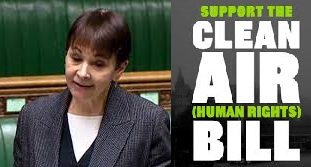
Just over a week ago, two events took place in Parliament which both involved the MP for Brighton Pavilion and both of them are important for us all. On Wednesday 17th January Caroline Lucas published a Bill, entitled, “Clean Air (Human Rights) Bill” and she has been offered the opportunity to discuss it as the second discussion later this year on Friday 14th June. Clearly this is very significant given the potential that the General Election could occur before June and given that she is retiring during the next General Election it is vital for other MPs to endorse it. So far five other MPs have endorsed her Bill. Two of which are Liberal Democrat and the other three are Labour MPs. I hope that more MP’s across the UK will see its vital importance.

This Bill is needed because, to put it simply, the state of our filthy air is a public health emergency. Air pollution is associated with conditions such as asthma, heart disease and cancer, and has been shown to have an impact on our mental health too, leading to an increased risk of schizophrenia, depression and anxiety. Its impacts are not equally felt, however, with those on low incomes and from black and ethnic minority backgrounds far more likely to live in polluted areas. It is children’s health that is affected most of all.

The beginning of the text was

That leave be given to bring in a Bill to establish the right to breathe clean air; to require the Secretary of State to achieve and maintain clean air in England; to involve the UK Health Security Agency in setting and reviewing pollutants and their limits; to enhance the powers, duties and functions of various agencies and authorities in relation to air pollution; to establish the Citizens’ Commission for Clean Air with powers to institute or intervene in legal proceedings; to require the Secretary of State and the relevant national authorities to apply environmental principles in carrying out their duties under this Act and the clean air enactments; and for connected purposes.

A couple of days after her Bill was published, Caroline created an Early Day Motion and its contribution was noteworthy. It is entitled “Right to Buy’’ She states

That this House notes that around 2 million council homes in England have been sold off to private individuals well below market value since the inception of the Right to Buy in 1980; further notes these homes were built using public money to create an essential collective asset fundamental to the post World War Two settlement; believes Right to Buy has been abused by property speculators and has decimated precious social housing stock as successive governments failed to replace the social homes being lost; supports the 2022 UK Housing Review conclusion that Right to Buy was a strategic failure; is concerned that the state is now giving billions in housing benefit to private landlords that should be invested in building new council housing; recognises the link between Right to Buy and the harmful commodification of housing, housing inequality and shortages for people on low incomes, the current homelessness crisis and record rates of children living in temporary accommodation; further believes that council housing needs to be provided and safeguarded for the housing needs and wellbeing of current and future generations; welcomes the abolition of Right to Buy in Scotland and Wales; and calls on the Government to protect and strengthen social housing by following suit in England, starting with an immediate suspension of all discounts, at the same time as investing in an ambitious programme to build new council homes.

This item deserves all party support and these events indicate the significance that the Green Party has held in Parliament.       

Posted in Brighton & Hove, Parliament and Democracy | Tagged , , , , | Leave a comment

Government states comments for Brighton Hospitals


Andrew Stephenson is the MP for Pendle in Lancashire and he is a member of the Government for Health and Social Care and on Thursday in Parliament he was involved in this discussion which is entitled in a discussion called “Milton Keynes Women’s and Children’s Hospital: New Hospital Programme” which involved two Conservative MPs from Milton Keynes. Andrew was involved in their discussion but one of his comments that took place included this comment

I would like to end by providing a more general update on the ambitious and vital work that we are undertaking as part of the new hospitals programme. I am very pleased that four hospital are now open to patients: the Northern Centre for Cancer Care; the Royal Liverpool Hospital; stage 1 of the Louisa Martindale, also known as the 3Ts hospital—trauma, tertiary and training—in Brighton; and the Northgate and Ferndene hospitals in Northumberland. A further hospital, the Salford Royal major trauma centre, is complete and due to open shortly. Another 17 hospitals are either in construction or in early construction with activity well under way to prepare their sites. This includes surveys and crucial work on non-clinical infrastructure, such as energy centres, demolitions or car parking.

It is very significant in Brighton that a new Hospital Building called “The Louisa Martindale Building” which is defined as “The Louisa Martindale is now fully open and is the home to 28 clinical wards and departments. It is the new main entrance for the hospital with connections to the rest of the hospital and the new underground car park.” and the text for Louisa is “Louisa Martindale, CBE FRCOG (30 October 1872 – 5 February 1966) was an English physician, surgeon, and writer. She also served as magistrate on the Brighton bench, was a prison commissioner and a member of the National Council of Women.”

Posted in Brighton & Hove, Parliament and Democracy | Tagged , , | Leave a comment