MP asked about Audio Visual for Bus Operators


A couple of weeks ago on the 16th January an SNP MP, Graham Leadbitter, from Moray West, Nairn and Strathspey, raised a question which refers in detail to the contributions that Audio Visual systems can make. The response from his question came from Simon Lightwood the Labour Minister for Parliamentary Under-Secretary (Department for Transport).

Interestingly three others referred to the use of Audio Visual in Parliament. On 10th January, Labour Minister Georgia Gould, The Parliamentary Secretary, Cabinet Office was responding to another question here. Earlier on the 8th January there was a significant item from the “Bus Services (No. 2) Bill [HL]” referred to in the House of Lords from the Conservative, Lord Holmes of Richmond who mentioned the work of  Audio Visual on here. Also briefly Baroness Bull, the Deputy Speaker (Lords) Crossbench Peer listed it on 30th January which is here.

The comment from Mr Leadbitter and Mr Lightwood is shown below in their document here. So far only one person has responded in support.

Graham Leadbitter: To ask the Secretary of State for Transport, what assessment she has made of the adequacy of the provision of audio-visual announcements by bus operators under the Bus Services Act 2017.

Simon Lightwood: We recognise the importance of audible and visible route and destination information in helping disabled people and other passengers to use bus services with confidence. On 1st October 2024 the first phase of the Public Service Vehicles (Accessible Information) Regulations 2023 (“Accessible Information Regulations”) came into force, requiring vehicles first used on local services since October 2019 to comply. The majority of local services should be compliant by October 2026.

The most recent annual bus statistics indicate that 37.2% of buses in Great Britain incorporated audible and visible route and next stop information provision as at 31st March 2024, but these statistics do not yet reflect the implementation of the Accessible Information Regulations.

Posted in Parliament and Democracy | Tagged , , , , | Leave a comment

MPs grill the Foreign Secretary in Commons


Last Monday in Parliament there was the potential for Sussex MPs to be involved with the e-Petition 652602 entitled: “Don’t increase the income requirement for family visas to £38,700” described as “Family Visas: Income Requirement”. 23 MPs spoke from locations across the South East from Kent, Surrey, London and elsewhere in the UK but sadly no comment from Sussex. Today a small e-Petition called “e-petition 657935 relating to speech and language therapy” which has been organised by Dave Robertson, the Labour MP for Lichfield near Birmingham will be discussed. It only included 13,188 signatures by the end of March last year when it was created with a few hundred signatures from the whole of the Sussex area. This e-petition was created by the Mikey Akers and called “Increase investment in Speech and Language Therapy.”

The only documents proposed by Sussex MPs this week is Tuesday afternoon with the Health and Social Care Committee, including Dr Beccy Cooper, the Worthing West MP but there are no contents listed for the discussion. It will be interesting to see what comes from this. There were a few significant sessions that involved some Sussex MPs that took place in the first couple of weeks of this new year. On Tuesday morning the 14th January one of the sessions was from the Foreign, Commonwealth and Development Officeand the MPs who responded included Chris Ward the Labour for Brighton Kemptown and Peacehaven and Sian Berry the Green from Brighton Pavilion. Both received responses from Labour Government members.

Mr Chris Ward said: “It is now over a year since Imran Khan was imprisoned in Pakistan. Since then, there have been reports of widespread intimidation and human rights abuses. Can the Minister set out what steps the UK Government are taking to protect human rights, democracy and the rule of law in Pakistan?”

Hamish Falconer, Parliamentary Under-Secretary (Foreign, Commonwealth and Development Office) replied: “The UK Government consistently urge Pakistani authorities to act in line with their international obligations and respect fundamental freedoms and human rights. I raised these issues during my visit to Pakistan in November and in my statement to the House on 28 November. We issued a further statement on 23 December about the role of military courts. We have made it clear that the UK supports individuals’ rights to freedom of assembly and expression, and we will continue to do so.”

A few minutes later Sian Berry added her comments: “Following up on the case of Alaa Abd el-Fattah in Egypt, will the Secretary of State say when he expects a substantial response to his engagement with the Egyptian Government? Will he confirm that he will not travel to Egypt unless he is confident that he can return with Alaa?”

David Lammy, Foreign Secretary, the minister for the Foreign, Commonwealth and Development Office: “Our relationship with Egypt is multifaceted. Today, this House has discussed the hope of a hostage deal, and the hon. Lady will understand the importance that the Egyptians play in that. As I said, I raised this issue on Sunday. I raised it on 20 December. I have pressed for Alaa’s release, and we will continue to do all we can, including the Prime Minister and the National Security Adviser. In the end, this is in the hands of the Egyptians.”

The next session that same day was called “Drones: High-security Prisons” and the first Sussex person who commented was Josh Babarinde, the Liberal Democrat MP for Eastbourne:

“The word that was missing from the shadow Justice Secretary’s question just now was “sorry”. A National Audit Office report said of the then Conservative Treasury’s investment in prison maintenance and security that “capital budget allocations for prisons have been well below the level needed.” Who was a treasury minister at that time? None other than the shadow Justice Secretary. Today’s report is the latest chapter in a catalogue of Tory prison failures that scuppered their mission to reduce reoffending, and therefore let down victims of crime. Will the Minister tell us about a new approach to better empower governors with the investment and the autonomy needed to properly invest in prison maintenance and security? What investment will he make in prison officer recruitment through programmes such as Unlocked Graduates, which are critical to help drive security in our prisons?”

Nicholas Dakin, The Parliamentary Under-Secretary of State for Justice: “The hon. Member is right about the failures missing in the shadow Minister’s question. He is also right to ask what the Government are doing to support prison officers and prison governors. We are investing in that, and we will announce a new programme for training and developing new governors very shortly.”

A few minutes later Jessica Brown-Fuller, the Liberal Democrat for Chichester added her comments: “LiveLink Aerospace in my constituency is a surveillance company that has created a technology that is being used on Royal Navy ships, in airports and on private yachts. This technology could be crucial to maintaining the no-fly zones above prisons, which were introduced in January last year. Will the Minister explore this technology? Will he come to my constituency to visit LiveLink Aerospace and see what the technology can do?”

Nicholas Dakin responded with: “It is important that we take advantage of what intelligence is out there. If the hon. Lady writes to me, I will be happy to follow that up appropriately with her and the business involved.”

Posted in Parliament and Democracy | Tagged , , , , , | Leave a comment

Bishop of Gloucester ask about Prisons: Health Services


Last week in the House of Lords on Tuesday on 14th January there was a discussion about “Prisons: Health Services” The session was opened by Delyth Morgan who is the Baroness Morgan of Drefelin and a few minutes later it was followed by Rachel Treweek who is The Bishop of Gloucester, who made a very good comment.

Here is the open comments from Delyth and the comment from Rachel.

The Labour Parliamentary Under-Secretary for Health and Social Care, Baroness Merron who is Gillian Merron, responded to all of the members on this item.

Baroness Morgan of Drefelin: To ask His Majesty’s Government what assessment they have made of the provision of health services in prisons.

Baroness Merron: My Lords, a full health needs assessment for every prisoner is undertaken at least every three years by NHS England, which then updates service specifications and commissions appropriate services to ensure that the health needs of offenders are being met. All 19 health service specifications for prisons and other detention environments are currently being updated to ensure that they remain fit for purpose and are expected to be published by March 2026.

Baroness Morgan of Drefelin: My Lords, I thank my noble friend for her Answer. I have heard first hand, through the work of the charities the Prison Reform Trust and Revolving Doors, about the challenging and degrading experience that some prisoners have had trying to access healthcare. Does the Minister agree that there is a huge opportunity to make progress here with the development of better facilities in new prisons? Does she also agree that it be would a positive thing to include prison healthcare services in ICBs’ commissioning to ensure that people in secure settings have access to the advances and developments that are available in the community?

Baroness Merron: I certainly agree with my noble friend that there are huge opportunities to improve healthcare for prisoners. On new prison design, I reassure her that all prison design will be fit for purpose because medical architects will be commissioned. That new design includes, for example, medical cells so that as many healthcare needs as possible can be met in prison. On my noble friend’s point about ICBs, it is a retained service, so it is not currently delegated to ICBs. It is the responsibility of health and justice commissioners to collaborate closely with ICBs to ensure continuity of care. The electronic referral service means that patients in prison can have access to the developments to which others in the community have access.

Here are the Bishop of Gloucester’s comments:

The Bishop of Gloucester: My Lords, women in prison have very specific health needs. Will the new women’s justice board look at ensuring that health and social care services across the women’s estate are consistently gender-specific and sensitive to women’s protected characteristics?

Baroness Merron: I can give that assurance to the right reverend Prelate, and I certainly agree about the particular needs of women in prisons. It is perhaps helpful to tell your Lordships’ House that new women’s health and well-being hubs will begin in all 12 female prisons from 1 April

Posted in Church Teaching, Health Reform, Parliament and Democracy | Tagged , , | Leave a comment

MP’s plan to create a domestic abuse offence


This week in Parliament includes events for Sussex MPs as published on the ‘TheyWorkForYou’ website. On Wednesday afternoon, listed as “New Hospital Programme” in the House of Commons run by Kieran Mullan, the Conservative MP for Bexhill and Battle. On Friday there will be 15 Proposed Bills from members of Parliament. The 5th item is “Domestic Abuse (Aggravated Offences) Bill: Second Reading” which is proposed by Josh Babarinde, the Liberal Democrat MP for Eastbourne.  He previously referred to it on 9th December 2024 which was supported by 11 Liberal Democrat MPs across the UK and Alison Bennett the only Sussex MP based in Mid Sussex. He did reference the “Early Release Scheme” on 10th December 2024 which stated

“I have introduced the Domestic Abuse (Aggravated Offences) Bill to create a specific set of domestic abuse aggravated offences—a bit like racially aggravated offences—that could be excluded from early release schemes. Women’s Aid is backing my Bill; will the Secretary of State back it, too?”.

Josh commented on “Violence against Women and Girls” on 9th January 2025, He stated:

“I convened survivors, academics and support organisations to come up with a solution, which exists in the form of a Bill that I introduced: the Domestic Abuse (Aggravated Offences) Bill, which would create a specific offence of domestic abuse in law for the first time. It would work in a similar way to racially and religiously aggravated offences by creating domestic abuse aggravated GBH, ABH or whatever it might be. Beyond giving the means for the Government to exclude domestic abusers from an early release scheme, it would tighten up some of the data, which is very difficult for academics and others to analyse when they are looking into the effectiveness of interventions.”

This afternoon includes the e-Petition of 652602 entitled: “Don’t increase the income requirement for family visas to £38,700” which has had 101,321 signatures since December 2023 and was created by Shannon Korkmaz. In Sussex, all areas had at least 0.1% signatures for this petition with a total of 2,911 and the biggest being Brighton Pavilion and Hove with 926 signatures. It will be interesting to see if any of our Sussex MPs will take part today. Irene Campbell, the Labour MP for North Ayrshire and Arran Scotland near Glasgow is supporting the e-Petition for more MPs to sign for what she refers as “relating to the income requirement for family visas”.

Beccy Cooper, the Labour MP for Worthing West has been debating the Tobacco and Vapes Bill which emerged on 7th January and several days since including last Tuesday. Across the UK there are 11 Labour, 4 Conservatives and 1 Liberal Democrat MPs supporting the Bill. Helena Dollimore, the Labour/Co-operative MP for Hastings and Rye has been discussing “Water (Special Measures) Bill”, on 9th January and again last Tuesday. This Bill also has support across the UK from 11 Labour, 3 Conservatives and 2 Liberal Democrat MPs.

The other significant debate was last Monday, created by Alison Bennett, she proposed the Sixth-Form College Strikes: Sussex. It was very good to see her comments but disappointing that no other Sussex MPs have been involved although there were comments from other people in Parliament. Her first open comment was:

“In my constituency, our young people are fortunate to have several highly regarded sixth-form options, including three brilliant colleges just over the constituency boundary in Brighton, Hove and Horsham. Varndean is one of only a handful of state-funded colleges offering the prestigious international baccalaureate; students at BHASVIC—Brighton, Hove and Sussex sixth-form college—received over 50 offers to study at Oxford and Cambridge last year; and Collyer’s has the best results in west Sussex and is in the top 15 colleges nationally for value added.

Since late November, those three local colleges have been among 32 across England, including one in the Minister’s constituency, that have held seven strike days—four before Christmas and, to date, three in January. I secured this debate having already submitted written parliamentary questions, the answers to which further frustrated those caught up in the dispute. In my opinion, the Government have dropped the ball on fairly and adequately funding non-academised sixth-form colleges. I feel that teachers are being treated unfairly and that students in Mid Sussex and beyond are being badly failed as a result.

Alison spoked at the end

“Why would sixth-form teachers take this step and cause more disruption to their students?… In July, the Government accepted the recommendation of the School Teachers Review Body to increase the pay of teachers in schools by 5.5%, and £1.2 billion of funding was provided for that pay award, but the Government excluded teachers at non-academised sixth-form colleges, yet they do exactly the same job as those in academised sixth-form colleges and at maintained schools. So far, the Government have provided two explanations for that illogical decision. First, in response to my parliamentary question, they said: “The government is not responsible for setting or making recommendations about teacher pay in further education…colleges, including sixth form colleges.”I close…. by urging the Minister and the Government to reconsider their approach; to find the small amount of money remaining to ensure that teachers are paid the same for the same job; and to finally put this cohort of students, whose education was most affected by covid disruption, at the centre of decisions made by Government that affect them.”

Posted in Parliament and Democracy | Tagged , , , , , , | Leave a comment

MPs debate on strike by sixth form teachers


Today and this week in Parliament several items will be presented by Sussex MPs for Minsters to consider. The Mid Sussex Liberal Democrat MP Alison Bennett has organised a debate in the main Chamber of the House of Commons today about the “Impact of sixth form college strikes in Sussex on students”. Interestingly Phil Clarke the South East regional secretary for the National Education Union spoke in an interview last week, “No teacher wants to be taking strike action…. They want to be in classrooms doing what they do best: teaching.” He further commented saying it was “simply unjust” that sixth form college teachers have not been included in the pay increase awarded to all other teachers. He warned that lower pay at these colleges would impact the students because staff would leave for better paid teaching work.

Today at 4.30-7.30pm an e-Petition, 661407 “Give parents/guardians a right to access social media accounts of their children” organised by Lewis Atkinson, the Labour MP for Sunderland Centralwill be discussed.It achieved 126,033 signatures by the 30th May 2024.A total of 3,700 for the whole of Sussex. Cheltenham has 6,315 signatures and the rest of the UK has similar signature numbers to Sussex.  

No Sussex MPs took part in the e-petition last Monday, 700143 “Call a General Election” event arranged by Jamie Stone, the Caithness, Sutherland and Easter Ross for Liberal Democrat MP. However, a few of our MPs spoke in the afternoon debate which took place at the same time as the e- Petition.  

The first debate Health and Adult Social Care Reform with Wes Streeting, the “Secretary of State for Health and Social Care” and MP for Ilford North making a statement.

Alison Bennett responded: “I would appreciate it if the Secretary of State could unpack a phrase in his statement. He said: “Where we can treat working people faster, we will”. That phrase is ripe for misinterpretation. Please could he explain what that means? Does it mean stay-at-home mums waiting for an appointment, and family carers, 26% of whom are on waiting lists?”

Wes responded to Alison with: “It does. I was talking about the fact that working class people are often left behind in a two-tier system where those who can afford it pay to go private, and those who cannot are left behind. It is the determination of this Government to bring back to life the essential Bevanite principle of an NHS that is there for everyone when they need it: healthcare available to all on the basis of need, not on ability to pay.”

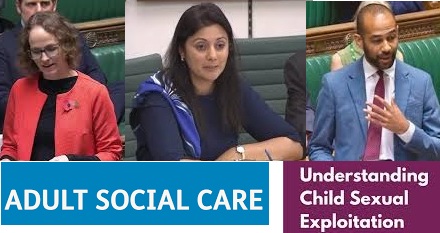
At 5pm there was a discussion of Child Sexual Exploitation and Abuse

With Nusrat contributing: “Before I call the Home Secretary to make the statement on child sexual exploitation and abuse, I have a statement to make on behalf of Mr Speaker. I remind Members of the House’s sub judice resolution, which prohibits reference being made to any active criminal cases. Members should therefore not make any reference to any active case in which an individual has already been charged.”

Yvette Cooper, Home Secretary, and MP for Pontefract, Castleford and Knottingley made a significant statement: “All of us have a responsibility to protect our children…. That is why this Government are determined to act, strengthening the law, taking forward recommendations from independent inquiries, and supporting stronger police action and protection for victims. There is no excuse for anyone not to take these crimes seriously. Brave survivors speaking out have shone a light on terrible crimes”

Yvette referred to the report “led by Alexis Jay who engaged with more than 7,000 victims and survivors, processed 2 million pages of evidence, and published 61 reports and publications. The findings should be truly disturbing for everyone”

Josh Babarinde, the Eastbourne MP for Liberal Democrat contributed Josh: “Considerable evidence tells us that children exposed to domestic violence are at increased risk of abuse themselves. Growing up, I was one of those children, and as a survivor I am appalled to have seen the shadow Home Secretary weaponize this issue in the way we saw earlier, I am appalled to see the likes of Reform play this issue like a political football, and I am appalled that zero of the 20 recommendations in Professor Jay’s report have been implemented so far. In the light of the link between domestic abuse and child abuse, I have tabled a Bill to create a dedicated set of domestic abuse offences in the law for the first time. Will the Home Secretary meet me to discuss the Bill’s provisions and how we can better respect and protect survivors across the country?”

Yvette: “I thank the hon. Member for speaking out about his personal experiences. I realise that is never an easy thing to do, and I respect him for doing it. As he says, there are all kinds of links, and domestic abuse in the household has an incredibly damaging impact on the family and on children growing up. We have to see the work on the protection of children as part of the wider work on public protection, and as being strongly linked to our mission to halve the incidence of violence against women and girls over the next 10 years. The safeguarding minister will be keen to discuss with the hon. Member his proposals relating to domestic abuse and how we can work together on these issues.”

Posted in Parliament and Democracy, Youth Issues | Tagged , , , , , , , | Leave a comment

STEM discussed in Parliament during December 2024


During December 2024 there were many significant debates in the House the commons. The most recent item was on the 30th December in the House of Lords, created by Baroness Smith of Malvern who referred to a question from the Baroness Wolf of Dulwich who asked about “Young People: Surveys” see below.

Just over 10 days ago two questions were asked on the 19th December. The first, from Fabian Hamilton the Labour MP for Leeds North East who asked “Educational Institutions: Staff” His response was from Catherine McKinnell who mentioned STEM see here. On the same day there was a question in the House of Lords from Lord Blunkett, he asked about STEM shown here.

Chichester MP, Jessica Brown-Fuller commented on the 18th December during the Creative Arts Education and her comments are shown below:

Jessica Brown-Fuller: I am glad that the hon. Member is the first person in the room to raise STEAM. Adding arts to the STEM subjects is such an important and viable way of opening up the curriculum. When I visit private schools in my constituency, their arts departments are flourishing. An article in The Times in November found that nearly half of all film and television directors nominated for British Academy of Film and Television Arts awards were educated at independent schools, and one in six was educated at Oxford or Cambridge. That highlights the stark class inequalities in access to the creative industries, which will worsen if the trend of de-prioritising arts education in state schools and colleges continues.

On the 10th December, Janet Daby, the Labour “Parliamentary Under-Secretary of State for Education” in her response from two questions from Ian Sollom, Liberal Democrat MP for St Neots and Mid Cambridgeshire who asked about “Mathematics: Higher Education”, see here.

Janet referred to a response back in the 5th December from Tan Dhesi, the Labour MP for Slough who asked about “Higher Education: Science” see here.

There was a session in the Scottish Parliament for the School Curriculum (Practical Science) on the 5th December and it seen here.

An event on “Critical Minerals: Domestic Production — [Carolyn Harris in the Chair]” had contributions by Perran Moon, the Labour MP for Camborne and Redruth. A bit later, Noah Law, the Labour MP for St Austell and Newquay mentioned it. Their words are below:

Perran Moon: Giving more support to this industry will increase its credibility as a possible career path in the education system. Camborne School of Mines, the UK’s only dedicated mining college, and perhaps the world’s most famous, offers sector-specific undergraduate courses, but we require greater focus on STEM subjects—science, technology, engineering and maths—at GCSE and A-level, alongside apprenticeships. To conclude—I am sure hon. Members will be relieved to hear that—

Noah Law: For the industry to flourish, we must address the skills gap. Institutions such as the Camborne School of Mines, which we have already heard about, and the Truro STEM centre are at the forefront of educating the next generation of workers for the industry. I look forward to the forthcoming investment in Cornwall college in the next year or so, as historically it has been an excellent source of talent for further education. The potential is immense: more than 100 degree-level apprenticeships could be offered at Camborne alone, and a similar number of mineral processing apprenticeships are available in Truro. Each major player in the critical minerals industry forecasts the need to train around 300 staff just in terms of direct employees, not to speak of the vast supply chain required. That makes it ever more crucial that we harness local talent to plug into the supply chain.

There were two more written items on the 3rd December. One from James Asser the Labour MP for West Ham and Beckton who asked “To ask the Secretary of State for Education, what steps her Department is taking encourage the take-up of STEM subjects at further education level.” The response from Janet Daby who included STEM and that can be seen here.

A Teachers: Labour Turnover question from Sarah Hall the Labour/Co-operative MP for Warrington South and the response included STEM from Catherine McKinnell the Labour “Minister of State (Education)”.

Then on the 2nd December there were three written STEM questions; “Girls” by Samantha Niblett the Labour MP for South Derbyshire who asked “To ask the Secretary of State for Education, what plans she has to encourage more girls into STEM subjects.” and it can be seen her. There was a Recruitment contribution by Jo Platt, the Labour / Co-operative MP for Leigh and Atherton STEM here. There was also a House of Lords session for Employment: Women from the Lord Taylor of Warwick and after he asked his question was provided by Baroness Smith of Malvern who mentioned STEM and that can be seen here.

Posted in Education, Parliament and Democracy, STEM, Youth Issues | Tagged , , , , , | Leave a comment

MPs to debate e-petition calling for a new election


Today in Parliament the e-petition 700143 with over three million signatures will be discussed, “Call a General Election” which includes “I would like there to be another General Election. I believe the current Labour Government have gone back on the promises they laid out in the lead up to the last election.” Jamie Stone, Liberal Democrat MP, for Caithness, Sutherland and Easter Ross in the North East Scotland MP organised that e-Petition. The most significant total of Sussex signatures for this e-Petition is in Arundel and South Downs, represented by Conservative MP Andrew Griffith with nearly 7,000 signatures. In East Sussex, Sussex Weald and Bexhill and Battle and in West Sussex at Bognor Regis has more than 6,000 people. All other areas are less in number but at least 3,000 apart from Brighton Pavilion with 2,700. Signature numbers were very small until early October 2024 increasing as of November that year. Another e-Petition event called “Fireworks: Sale and Use” which required the items 639319 and 700013 was debated last Monday 9th December 2024. Andrew Griffith did respond. Let us hope that this year many other Sussex’s will contribute.

Also on Monday 13th January, Alison Bennett, plans to discuss the “Impact of sixth form college strikes in Sussex on students”. Later Josh Babarinde, the Eastbourne Liberal Democrat is providing his own “Domestic Abuse (Aggravated Offences) Bill” on Friday 24th January.

A number of Committees have been set out, Beccy Cooper, Labour MP for Worthing West, proposes “Tobacco and Vapes Bill”.  “To consider the Bill Oral evidence” Helena Dollimore, Labour MP for Hastings and Rye for the “Environment, Food and Rural Affairs Committee” and the “Water (Special Measures) Bill [HL]” John Milne, Liberal Democrat for Horsham, the “Work and Pensions Committee” discusses the “Safeguarding vulnerable claimants” contribution. Peter Lamb, Labour MP for Crawley, the “Public Administration and Constitutional Affairs Committee” which includes “Review of the 2024 general election”. Jess Brown-Fuller, the Liberal Democrat for Chichester looks at “Backbench Business Committee” and Alison Griffiths, the Conservative MP for Bognor Regis and Littlehampton the “Business and Trade Committee.” The “Finance Committee (Commons)” involves Nusrat Ghani Conservative for Sussex Weald and James MacCleary Liberal Democrat for Lewes.

Sian Berry’s contributed to the WASPI statement made by Work and Pensions secretary Liz Kendall on the 17th December. This has been an extremely difficult decision to take

Liz Kendall stated that her report was of her words: “I want to be clear about what this report investigated, and what it did not. The report is not an investigation into the actual decision to increase the state pension age for women in 1995 or to accelerate that increase in 2011— a decision that the then Conservative Chancellor George Osborne said “Probably saved more money than anything else we’ve done”. That comment understandably angered many women and sparked the original Women Against State Pension Inequality Campaign. The ombudsman is clear that policy decisions to increase the state pension age in 1995 and since were taken by Parliament and considered lawful by the courts. This investigation was about how changes in the state pension age were communicated by the Department for Work and Pensions, and the impact this may have had on the ability of women born in the 1950s to plan for their retirement…. Given that the vast majority of women knew the state pension age was increasing, the Government do not believe that paying a flat rate to all women, at a cost of up to £10.5 billion, would be a fair or proportionate use of taxpayers’ money, not least when the previous Government failed to set aside a single penny for any compensation scheme and left us a £22 billion black hole in the public finances…. research from 2004 showing that 43% of women aged over 16 were aware of their state pension age…. Secondly, the report says that if letters had been sent out earlier, it would have affected what women knew about the state pension age. However, we do not agree that sending letters earlier would have had the impact that the ombudsman says…. “These two facts—that most women knew the state pension age was increasing and that letters are not as significant as the ombudsman says—as well as other reasons, have informed our conclusion that there should be no scheme of financial compensation to 1950s-born women in response to the ombudsman’s report”.

Sian: “This is a very harsh statement. It admits wrongdoing but offers a bitter dose of nothing to a generation of women who already faced prejudices and disadvantages in their careers and were caught out by Government decisions. If the Secretary of State will not reconsider her decision despite being urged to do so by Members on both sides of the House, what else will she do to ensure that those women can enjoy levels of security in retirement closer to equal those of their male counterparts?”

Liz: “This Government will protect the pensions triple lock, so your state pension will increase by up to £1,900 a year by the end of this Parliament; we will drive down waiting lists, so you get the treatment you need, with an extra £22 billion of funding for the NHS this year and next; and we will deliver the jobs, homes and opportunities your families need to build a better life”

Many women’s groups have been widely reported to clearly demonstrate their disappointment.   

Posted in Parliament and Democracy | Tagged , , | Leave a comment

Norwich Bishop spoke in the House of Lords at 2024


The current Bishop of Norwich is Graham Barham Usher, included into the House of Lords from November 2023, after he became the bishop in 2019.

Most recently he spoke on 30th December 2024 about Special Educational Needs and he raised two questions  below here The response came from Labour Baroness Smith of Malvern,  Minister of State (Education), Lords Spokesperson (Equalities):

The Bishop of Norwich: To ask His Majesty’s Government what assessment they have made of the: Safety valve agreement, and of its impact in the local authorities where such agreements have been made AND Impact on the most vulnerable pupils with special educational needs in local authorities where a safety valve agreement has been made; and how they propose to minimise this impact.

Baroness Smith of Malvern: Safety Valve agreements were only entered into if the local authority and the department’s expert advisers agreed that the proposals would improve services for children and young people with special educational needs and disabilities (SEND) whilst enabling local authorities to meet their statutory obligations. Safety Valve agreements do not in any way release local authorities from their obligation to fulfil their statutory duties to children and young people with SEND.

The department is also conducting a research project into the impact of Safety Valves in local areas. This will help us further understand the experience of children, parents, carers and schools.

The department has confirmed that it will not enter into any more Safety Valve agreements for councils that have financial deficits, pending wider reform of the whole system to prioritise early intervention, properly supporting councils to bring their finances under control. We will will continue to work with local authorities that have Safety Valve agreements with the department, to deliver their plans.

Previously, Graham had raised questions about two other themes in December 2024. On 3rd December he asked about “Agriculture: Inheritance Tax” that is here with a response from Lord Livermore the Financial Secretary to the Treasury for Labour:

The Bishop of Norwich: To ask His Majesty’s Government what assessment they have made of the impact of the Budget’s changes to agricultural property relief from inheritance tax on the mental health of farming families who own small farms.

Lord Livermore: At the Budget, the Government took a number of decisions on tax, welfare, and spending to restore economic stability, fix the public finances, and support public services. The Government has done so in a way that makes the tax system fairer and more sustainable.

At the Budget, the Government set out that, from 6 April 2026, in addition to existing nil-rate bands and exemptions, the 100% rate of relief will continue for the first £1 million of combined agricultural and business assets, and the rate of relief will be 50% thereafter.

Almost three-quarters of estates each year claiming agricultural property relief, including those that also claim business property relief, are expected to be unaffected.

The Government is committed to supporting farmers and agricultural workers in accessing the support that they need as they undertake the vital work of producing food and looking after the environment. For example, through its Farming and Countryside Programme, the Department for Environment, Food and Rural Affairs (Defra) already works with a range of farming charities, including the Royal Agricultural Benevolent Institution and the Yellow Wellies charity, which have highlighted mental health challenges for farming communities.

Also, on the 12th December Graham was involved in a debate “Small Farms and Family Businesses – Motion to Take Note” and in a later debate the Bishop of Newcastle participated. All of the text is here and Graham’s comment:

The Bishop of Norwich: My Lords, I am grateful to the noble Earl, Lord Leicester, for bringing this timely debate. Let us not beat about the hedgerow: the Government’s Budget proposals are bringing huge stress and deep concern to the farming community, as we have already heard. For many, this is the final straw after years of challenges.

I have become aware of a particularly tragic circumstance in south Norfolk where, due to a terminal cancer diagnosis, if the farmer survives after 5 April 2026, the policy change will have a huge impact on his family’s well-being and fortunes. That pressure puts enormous strain on him, almost wishing him to die sooner, because then the farm will be safe.

What of situations of the unexpected sudden death of a young farmer? The family would not only have lost the primary breadwinner but would probably have an unsustainable farm to carry on farming.

For others considering a lifetime gift, I am hearing deep concerns about the fact that you need to be able to afford to make it. The challenge is what you are going to live off or where you are going to live, because farming businesses have been squeezed in so many ways. In many cases, there is simply not the spare cash available outside funding capital, machinery and living costs.

All of this is affecting the well-being and mental health of our farming communities. The suicide rate among male farmers is three times the national average. Thank goodness, at a time like this, with added worries and pressures, that we have organisations such as the Farming Community Network and the excellent YANA charity in Norfolk ready to provide a listening ear and practical advice.

It is not just farming finances: there are wider implications of this policy change. If small farms have to be broken up or are no longer viable, there is a major risk of multinationals buying up family farms. That is likely to negatively impact the 30 by 30 biodiversity target, as research shows that smaller farms tend to have higher biodiversity.

A second impact, which I am sure the Government will be concerned about, is around community cohesion. Farming families have played, and continue to play, an important and valuable part as community leaders, volunteering in their neighbourhoods as local councillors and churchwardens, and running agricultural and county shows. Fewer farms, fewer people.

So let me dare to ask the Minister whether he will pledge to do two things. The first is simply to raise the threshold on APR. The Treasury’s own figures estimate that a substantial amount of the money raised through these reforms will come from the wealthiest 2% of farm estates. Raising the threshold will not make a great deal of difference in terms of tax revenue. Secondly, please tweak the rules around tax-free gifts made in the seven years before death and exempt people over a certain age, so that farm owners who die in the next seven years have an opportunity to make tax-avoiding gifts in light of the Budget changes. This seems to be eminently sensible and compassionate.

Wendell Berry, the American poet, essayist and farmer, has reflected that the agricultural economy has almost always, from the earliest times, been slanted against the primary producers, the real risk takers, the real workers. Our farming families feed our nation. They provide nature benefits. They contribute to the warp and weft of community life. We need them. We owe them a fair system. I urge the Minister to choose a positive way forward.

Posted in Church Teaching, Parliament and Democracy | Tagged , , | 1 Comment

MPs debate new review at Gatwick Airport


In the days leading up to the holiday period in Parliament two e-Petitions were arranged for the 16th December “Israel and Palestine” with 653509 “For the United Kingdom to recognise the state of Palestine immediately” with 283,669 signatures and item 652949 “Immediately revoke all licences for arms exports to Israel” with 107,316 signatures. Sadly, No Sussex MPs have contributed to the debate.

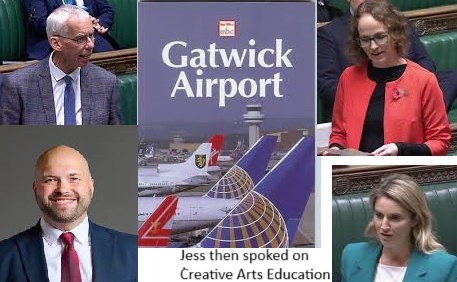
On the 18th December John Milne, Liberal Democrat MP for Horsham, debated the Gatwick Airspace Modernisation Review, joined by Alison Bennett, Liberal Democrat MP for Mid Sussex and Peter Lamb, Labour MP for Crawley.

John began I have brought today’s debate in order to represent growing concerns from residents regarding the airspace modernisation process around Gatwick, which is part of the future airspace strategy implementation south, known as FASI-S. Before I start, I would like to make it clear that I wholly support the modernisation process in principle. It is a vital step if we are to improve the efficiency of civil aviation, cut flight times and reduce carbon emissions…. The process as it stands involves a significant conflict of interest. I would also like to emphasise that the airspace modernisation process is entirely separate from the second runway application at Gatwick, although it is going on at the same time and naturally gets confused in the public mind. The airspace modernisation process will go ahead whether or not Gatwick obtains permission to expand and is in fact part of a national process also being conducted at 19 other airports across the UK”.                          

Alison added I have been concerned for some time about potential expansion at Gatwick airport, in particular bringing the emergency runway into commercial use. Does my hon. Friend agree that should the decision be approved, the problems he outlines will only be exacerbated?”

John respondedIndeed, there is a suspicion that part of the motive behind this is to enable an expansion, which has not been permitted yet. In this new design, flights would be concentrated over a much narrower band of countryside”.

Peter Lamb commented: “in 2014 I was on Gatwick’s consultative forum as a community representative and I was well aware then of the impact that the trial route had, in terms of concentrated noise in some areas and the consequent storm of community feeling….., one of the key problems will ultimately be that if we are trying to rationalise airspace with a complex set of interconnecting airports, there will only be a finite number of routes that can reasonably be taken…..My broader concern is that….. ultimately what we are doing is enabling far greater capacity in terms of flights in our region. As I am sure both the hon. Member and Alison Bennett will agree, north Sussex’s infrastructure is already completely overloaded from dealing with the existing levels of demand from the airport and the associated industries. Any growth in capacity will require someone—either the airport or the Government—to step in and significantly invest in our communities to make sure that they do not suffer the ill effects of far greater levels of aviation in our region.”

John Milne responded:Indeed, part of the problem is that this process is in isolation from 100 other issues; infrastructure is very much one of them, because, as he says, it is already sadly lacking….. the options show little to no variation from each other. It is not three choices; it is one choice repeated three times. Without sight of a genuine alternative that builds on the structure already in place—using routes that already bear traffic—how can the public understand the trade-offs of different pathways? It is worth noting that Heathrow has three clearly varying pathways, which differ in direction and geometric shape from each other, for the public to consider”.                                                             

Jess Brown-Fuller then spoked on Creative Arts Education

“It is a pleasure to open this debate…. I refer Members to my entry in the Register of Members’ Financial Interests, both as chair of the all-party parliamentary group on performing arts education and training and as trustee of Chichester Festival Theatre…. The arts and cultural sector contribute well over £8 billion to the UK economy each year. It puts £2.5 billion directly into the Treasury through taxation, and the creative industries as a whole generated £125 billion in 2022. They account for almost 6% of the UK economy, create 2.5 million jobs and have a huge impact on the tourism economy, with one in 10 tourists to the UK visiting a theatre. Theatres sell 34 million tickets a year across the UK…. I had a fantastic time as the guest judge at the Priory Park pantomime, and…. I will be off to enjoy the Chichester Festival Youth Theatre’s production of “Cinderella”—a professional production on the main stage—with my family…. After studying drama at GCSE and A-level, I went on to the University of Chichester and obtained a degree in performing arts. Before this giddy world of politics ensnared me, I had the privilege of teaching the next generation performing arts at various organisations and in schools. I am living proof that a creative education can lead anywhere, including to this place….I thank hon. Members, the shadow minister and the Shadow Minister for talking about the importance of creative arts education and how it will foster the next generation of well-rounded and emotionally intelligent young people, who can thrive”

Posted in Education, Parliament and Democracy | Tagged , , , | Leave a comment

Three MPs reference the YMCA in December 2024


It was significant that three UK MPs mentioned the work of the YMCA in their comments this month.

The first was Bradley Thomas, the Conservative MP for Bromsgrove, on the 3rd December in the discussion about “National Insurance Contributions (Secondary Class 1 Contributions) Bill” with three votes.

Later, Catherine Atkinson, Labour MP for Derby North, on 16th December commented as part of the “Youth Guarantee” discussion.

On the following day of 17th December, Gareth Snell, the Labour/Co-operative MP for Stoke-on-Trent Central, who referred to YMCA in the “Clause 1 – Rate of secondary Class 1 contributions” the day of the three votes.

As it happens I have also referred to the end of this year were four MPs that referred to YMCA’s during in October which are here and then during on November there were two other MPs who referred to YMCA’s which can be seen here. Below the three YMCA December comments are shown:

So for December, Bradley Thomas was speaking here:

Two thirds of businesses claim that they are looking at freezing recruitment or making job cuts. We have already heard hon. Members talk about the impact on the charity sector. In fact, during this debate, I received an email from YMCA, which said that because of the increase in national insurance that it will have to pay in Worcestershire, it will look to freeze all recruitment and probably make redundancies. It will not be able to give a pay award to any of its staff, and it will look at cutting services. That is damning. We see from the Government an ideological pursuit of a policy that is really a false economy. Labour is failing the very working person that it claims to be protecting.

Then Catherine Atkinson spoked it and also Liz Kendall from the Government speaking here:

Catherine Atkinson: Mel was out of work and homeless, but YMCA  Derbyshire saw only her potential, not her disadvantage. Now, she is at Toyota and on track for a leadership role. Its working assets programme has a 70% success rate in supporting homeless young people into employment. How will the youth guarantee help the Government join up with, enhance and champion local programmes like that?

Liz Kendall: That sounds like a fantastic programme by the YMCA in my hon. Friend’s  constituency. That is precisely why we need to join up with what local colleges are doing, with the support provided by local councils and with supported employment programmes run by the NHS. If we join that up and base it on local needs, her young constituent and many others like her will get the chance they need and deserve to build a better life.

Last in December was the comment from Gareth Snell from here:

The second largest impact I was told about is to the YMCA North Staffordshire, which will see its NI contributions rise by £101,000. That organisation routinely provides homes for young people who would ordinarily find themselves on the street, works with families to ensure that family units can stay together, supports community meal initiatives to bring together different Stoke-on-Trent communities, and does a lot of work on community cohesion, which is a particularly contentious issue in my city.

Posted in Parliament and Democracy, Youth Issues | Tagged , , , , | Leave a comment