
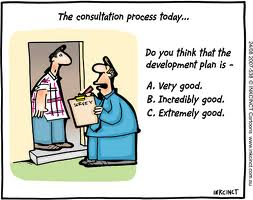
 The timing of the Newsnight interview with Russell Brand and this piece of analysis by Mark Easton of the BBC could not be more inconvenient for the Government and for Parliament as a whole. While Russell was explaining his desire for a new way of doing politics, and by implication that for 35%+ of ‘electors’ who ignore organised political discourse, Easton discovered how little attention the political classes pay to those of us who respond to their questions. I have already written about the Russell Brand interview here and the hostility of our Parliamentarians to lobby group 38 Degrees here. This morning I am reflecting on Eastons article published on Friday where he reviewed 3 Governmental consultations to which Ministers have responded in the last few days. What he has discovered is very dispiriting for those of us who bother to respond to such processes, although he is at pains to point out that no government can be expected to take these as a direction to act in isolation to other issues. Inevitably some consultations will be more balanced than others due to the extent to which single issue pressure groups participate out of proportion to the wider population and the quality of the questions which are asked in the first place.
The consultations that Mark reviewed are the Department of Work and Pensions response to a consultation on changes to the assessment of people with disabilities to determine their entitlement to benefits. Then two consultation responses by the Home Office, first to plans for a levy on temporary non-EEA migrants as a contribution towards the costs of NHS care and then to the proposed introduction of a legal obligation on landlords to check the immigration status of tenants. In all three cases the response of the British public, those who elect our MPs, those who MPs claim to be accountable to, have returned responses that are being entirely ignored by those very MPs. It is incredibly difficult to persuade people to engage in consultations, because doing so depends on reading long documents and making sense of the questions being asked as they are not necessarily the questions that informed people want to be asked. However this brief analysis of how our Parliament responded to these consultations gives a very good reason to ignore future consultations, unless Parliament is prepared to provide some form of compact with the nation that in future they will take these processes more seriously.
In case my argument for such a compact is assumed to be based on one week in Politics, a period which we know is a long one for Politicians, I can offer at least one more consultation that this Government has ignored. That was the consultation on the minimum pricing for alcohol. There is no good reason for ignoring the idea that the Government initially proposed, yet because of pressure from retailers and manufacturers we have lost the opportunity for a whole generation to help change behaviour that is having a damaging impact on all of our communities. If we are to have a compact of this sort with the Government, the same compact could be extended to include promises such as the one made by the previous Government, which was supported by the Conservative Party in opposition to repay £425M to the Big Lottery following the end of the Olympics. More information about the Big Lottery Refund can be found here. Perhaps if there was some form of compact between Parliament and the nation, there could be an increase in in trust between us and our Government might begin to win over some of those residents who are as resistant to our political processes as Russell Brand? In the light of the Royal Charter being proposed for the regulation of the press, maybe we could look for something similar to regulate our political processes?


 ianchisnall
Consultations are a means of ignoring the views of the public, rather than a genuine attempt to engage with them. Government bodies should abandon the use of sham consultation methodologies and invest in something radical like Open Strategies.
PS the problem with alcohol is consumption – minimum pricing P does not impact directly on quantity Q except in economics textbooks. We all know that in the real world people do not make rational economic decisions .. especially after a few drinks. Any government (or Police Commissioner!) serious about addressing the social impact of alcohol would need to adopt policies that target consumption more directly e.g. banning BOGOF or taking it off supermarket shelves altogether.
Richard, I think that the issue of rational decisions once inebriated misses most of the point as I see it. The minimum pricing (and clearly there needs to be detail) would mostly impact Supermarkets selling cheap drinks to people who are then free to go elsewhere, unsupervised and drink what they like. At home this means that partners may be at risk from too much alcohol, but perhaps more widely it leaves people free to leave the home already drunk to search out more of the same. It is this preloading, made easier by virtue of very low costs that is a big problem. I think there is plenty of evidence that price does affect behaviour when people are not drunk. It affects other products even outside the text books!
Morning Ian
Happy to concede that the rationality argument is not the most central one – I just threw it in for brevity. You still need to explain why despite probably already having some of the highest unit prices in Europe (http://www.mytravelcost.com/alcohol-prices/ e.g. more than twice as expensive as Spain) we still appear to have relatively high consumption (http://en.wikipedia.org/wiki/List_of_countries_by_alcohol_consumption e.g. higher than Spain), which is presumably why we also have some of the ‘worst’ behaviour. (Not sure how alcohol tourism by British nationals on the various Costas feeds into these figures though!)
This doesn’t really fit in with the concept of higher prices P changing purchasing behaviour Q in the direction one would expect according to the economics textbook. I have read at least one economics textbook in the past (!) and recall that an example of higher prices increasing consumption is the Giffen good. This is essentially driven by poverty, but a rational mechanism nonetheless. Perhaps alcohol is in this category in the UK.
Personally I think it also applies to housing – why on earth are we still rushing out to buy houses the more unaffordable they get? I have also noticed an element of consumer psychology in sales over the years whereby anything priced at below a certain threshold simply doesn’t get noticed by the consumer, presumably on a ‘no cost-no perceived value’ basis. These are much less rational mechanisms than the Giffen principle.
BW
Richard
PS looks as though you were spot on about the ‘Go Home’ vans!
Hi Richard
I am not an expert, but I understand that cost impacts on our behaviour in relative terms, gradually changing what we do and helping to shape our actions. I am certain that there are all sorts of factors to also consider.
Ian