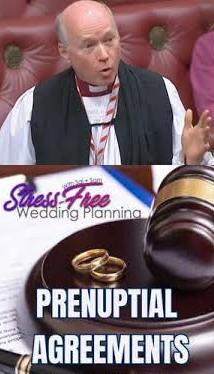
At the end of February there was a discussion in the House of Lords, ‘That this House takes note of the law relating to prenuptial agreements, ‘set out by Ruth Deech, an Independent Crossbench Peer. Several of colleagues spoke about it including the Bishop of Southwell and Nottingham, Paul Williams.
One of his comments was ‘I believe it would be detrimental for all parties if prenuptial agreements were to become a normal part of preparing for marriage, whether religious or not—although I entirely acknowledge the arguments in favour of these agreements, particularly the clarity they provide in financial matters, especially where there are pre-existing children, and their role in reducing litigation upon divorce.’
All of his comments are shown below and all of the comments from all members of the House of Lords took from 27th February, here.
The Bishop of Southwell and Nottingham: My Lords, I am grateful to the noble Baroness, Lady Deech, for bringing the debate on this Motion and for raising such fundamentally important issues, which she set out so clearly. I also acknowledge with respect the considerable wisdom and insight of the noble Baroness, Lady Shackleton, on these matters.
It has been my personal privilege to prepare many couples for marriage over the years. It is a hopeful time, where couples seek to express unconditional love and trust, and commit to share all aspects of their life, both at the time and looking to the future, whatever it may hold. I believe it would be detrimental for all parties if prenuptial agreements were to become a normal part of preparing for marriage, whether religious or not—although I entirely acknowledge the arguments in favour of these agreements, particularly the clarity they provide in financial matters, especially where there are pre-existing children, and their role in reducing litigation upon divorce.
However, I urge the House to reflect on prenuptial agreements’ broader implications for the institution of marriage, its gift to wider society and the potential consequences for the financially weaker parties. Historically, marriage has been regarded as more than just a contractual arrangement between two individuals. If we are to put matrimonial nuptial agreements into statute, it may appear as if we are saying to couples who come to marry that, to save themselves legal costs and uncertainty, they should include in their preparations a plan also for their divorce.
Furthermore, although advocates argue that prenuptial agreements encourage fairness and discourage litigation, we must be mindful of the power imbalances that may arise, which can be emotional, psychological and, of course, financial. The reality is that such agreements often favour the wealthier party, leaving the financially weaker spouse—often women—at a disadvantage.
When there is some sort of pressure to marry, individuals may agree to terms that are significantly unfair or that fail to consider future circumstances, such as career sacrifices, child-rearing responsibilities, unexpected financial hardships or even unexpected windfalls. Therefore, I believe the courts should retain a measure of discretion to ensure that any final financial agreement is equitable, rather than being bound by contracts that may no longer reflect the realities of the marriage or divorce. For this reason, of the models set out by the Law Commission in December 2024, I would favour that which codifies the current case law while retaining wider judicial discretion.
Although it is true that courts currently have the authority to assess and override prenuptial agreements in cases of significant inequality, there remains a risk that their increasing normalisation may lead to undue pressure on prospective spouses to sign away their rights without fully comprehending the longer-term, more serious consequences. For example, many prenuptial agreements incorporate acknowledgements that each party is content with the financial information that has been provided and does not wish to ask further questions before signing. Yet I am sure it is likely, at times, that one partner may be anxious about asking further questions in a way that may imply a lack of trust and so risk undermining the relationship at a time when the focus, in preparing for marriage, is very much orientated towards joyful expectation.
Marriage is not merely an economic transaction. It is, above all a covenant: something good and beautiful. We must ensure that our legal framework continues to foster the values of partnership and protection for the vulnerable. Whatever our views across this House, I hope we can acknowledge the value of good preparation for marriage, drawing on the very large range of excellent resources and support that is available. That includes support offered by organisations such as Care for the Family, one of a number of charities that have dedicated themselves in recent years to supporting churches in particular across the country as they offer support to those preparing for marriage, whether they are part of the church or not. In addition, they go on offering resources to support relationships at later stages of family life and in parenting—especially when challenges inevitably arise and the strain on the relationship increases. Let us, as a House, in the midst of this debate, value the work that is done by many individuals, organisations and faith-based communities to support preparing for marriage.
Therefore, in conclusion, I urge the House to approach the matter of nuptial agreements with some caution, ensuring that any legal recognition that they receive does not come at the cost of transparent fairness and justice and the true spirit of marriage, as a most ancient and sacred institution given by God that, at its best, benefits the whole of society.


 ianchisnall
12.3.25
TWO PARAGRAPHS OF SEVERAL.
Sent to all people in article incl H of C
PAUL WILLIAMS. NOTTS BISHOP. PRE NUPTUALS. CHISNALL IS REPORTING
IT..This is not the real truth about the UK, we looked into the
activity of Catholic and C of E Bishops and found we were being evaded
and that is backed by dangerous naive public propped up by media. The
violent Police who came here were sent by C of E. and Local Govt.
In this case we found Notts to be full of crrptn incl the University
which does cover ups re 10.000 mental health deaths carried out by HM
Coroners and enforced by Police attacks on us and death threats from HM
Courts. How is it Williams/Local Govt/HM MPs never noticed it. No HM MP
in UK has replied in 38 yrs. The Police have told us that the 1000 pp
evidence we gathered Cent London and elsewhere must not be seen by
public, they also said this- ‘If You Try To Pick Up The Food From The
Floor We Would Be Arrested’. No crime reports were acknowledged. Notts
Uni involved in Election rigging helped by Facebook who destroy evidence
on behalf of Govt and Times Media and Electoral Commission and Local
Govt. The HM MP Notts City has been assoc with cover ups re deaths
because she was involved with Unison who were the people in the giant MH
Hospital we moled, after we were told not to resolve their clients
issues because the victims are used to do repetitive work for firms.
they, Unison told us the place had killed people. When we turned up at
Cent London HM Coroner they tried violence so we went and hid in a
doorway and could see them hiding behind curtains, so we pretended to go
home and immediately a huge group of people came out and ran towards
station, they incl Next Kin and the Police who had killed the relative.
There must be bribes going on. We found out that no HM Coroner would
respond cept one. She admitted what is going on. We don’t know if she is
alive. Then the HM Courts offered to kill us. When we turned up at one
HM Court they all ran out the back and disappeared. We took on board
bodyguards because otherwise we would be alive